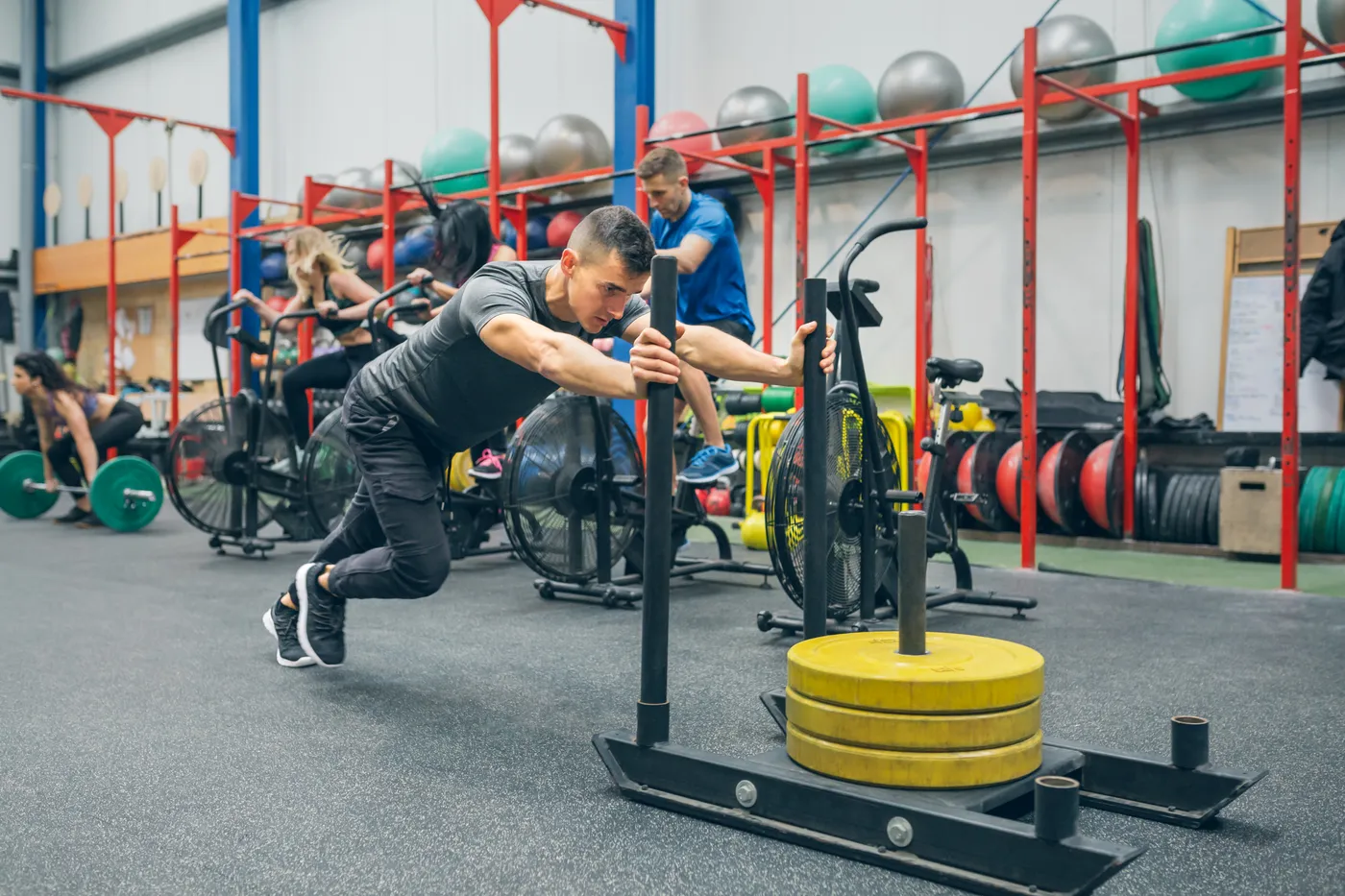
Circuit training is a workout method in which you move through a sequence of exercise stations — one after another, usually on a timer — with short rests between them. Each station loads a different movement pattern or energy system, so one part of the body recovers while another works. The payoff is density: a session that trains strength and cardiovascular fitness together in less clock time than training them separately.
The anatomy of a circuit
- Stations — a handful to a dozen exercises set up around the room: resistance work, cardio machines, bodyweight movements
- Work intervals — a fixed effort period at each station, dictated by a timer rather than a rep count
- Transitions — brief windows to move to the next station, which double as partial recovery
- Rounds — one full lap of the stations; sessions typically run several
That timer-driven rotation is what separates circuits from traditional sets-and-rests lifting, where you finish all your work on one exercise before touching the next.
Density is the point
The defining feature of circuit training is more quality work per minute. Because rests are short and the next station uses different muscles, your heart rate stays elevated throughout while each muscle group still gets local recovery between its turns. The honest trade-off: those short rests cap how heavy you can go, which is why circuits build general strength well but aren't the tool for chasing one-rep maxes — maximal lifting demands long rests that circuits deliberately avoid.
Strength and cardio in one session
A well-built circuit alternates its demands — a lower-body strength station into a treadmill push into an upper-body pull into conditioning rounds — so the session becomes simultaneously a resistance workout and a conditioning workout. For general fitness, that blend is a feature, not a compromise. Inside a coached group session, this is typically the structure running the whole room; what a class looks like from the inside shows how the rotation plays out with a coach and a timer in charge.
Who the method suits
Circuits fit time-poor generalists who want strength and engine in one visit, beginners who benefit from short exposures to many movements, and anyone bored senseless by straight sets. The rotation format is also why circuits dominate group training: many people at many levels can share one room, each scaled at their own station. They suit specialists less — a powerlifter peaking a squat or a marathoner in a sharpening block needs focused work that a rotating format can't prioritize.
To see the method run live rather than on paper, circuit training classes in North Vancouver is that format with a coach in the room.
Common questions
Is circuit training the same as HIIT?
They overlap but aren't synonyms. HIIT is defined by intensity — near-maximal efforts with recovery periods — while circuits are defined by station rotation. A circuit can be run at HIIT intensity, but many circuits run at steadier efforts.
Can you build real muscle with circuits?
Yes, particularly in your first year or two of training, provided the loads genuinely challenge you and increase over time. Advanced muscle-building eventually needs the focused volume of dedicated hypertrophy work.
How often should you do circuit training?
Two to four sessions a week works for most people, with at least a day between hard sessions early on. The full-body nature of circuits means recovery matters more than it does with split routines.
Do you need special equipment?
No — the method is the rotation, not the gear. Dumbbells, bands, a skipping rope, and floor space make a complete circuit; machines and treadmills expand the options but aren't required.