
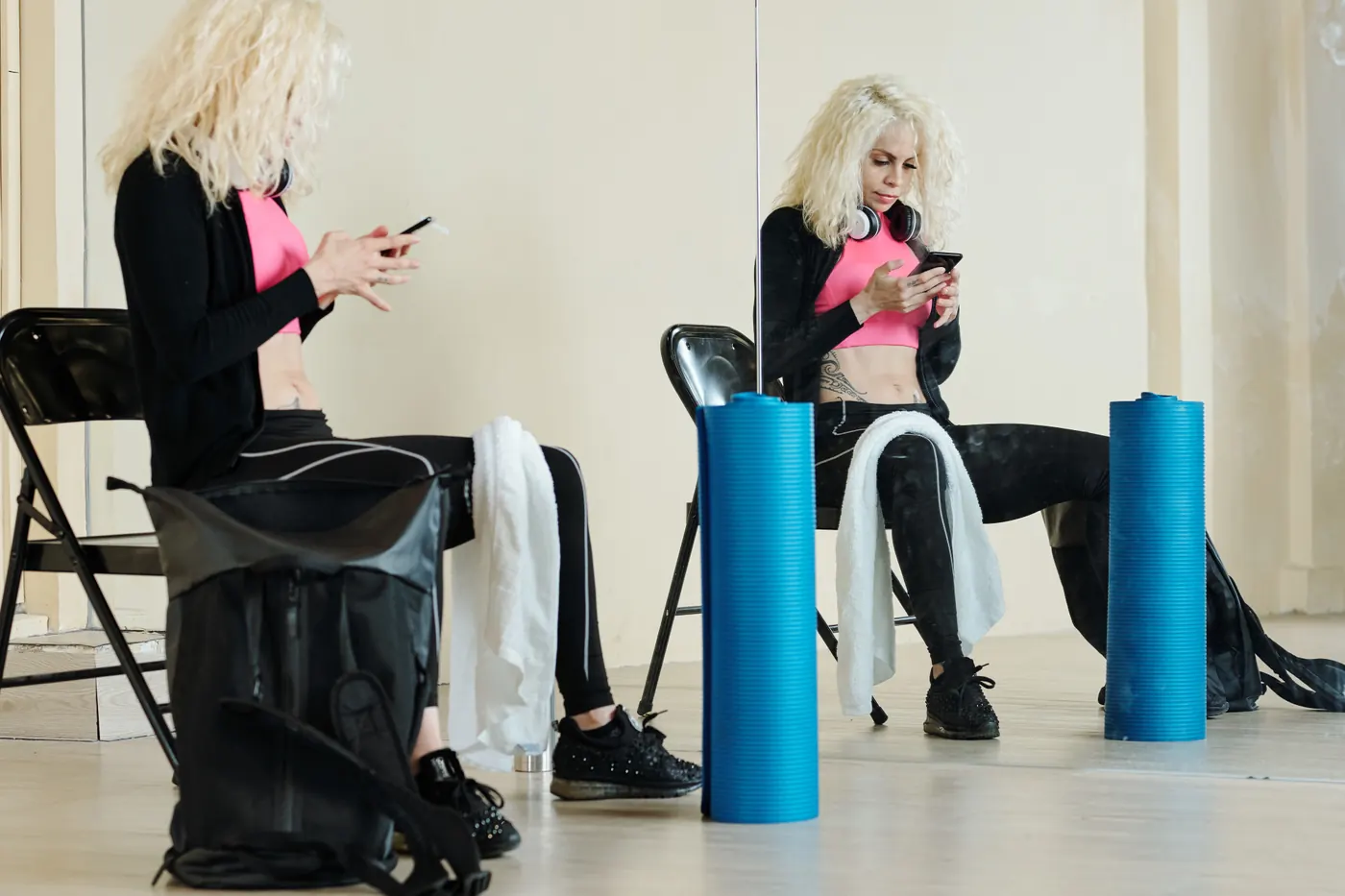
An AI fitness app in 2026 writes a competent program, adjusts it to what you log, and costs a small fraction of a coach. A personal trainer does what the app cannot: watch the set, see how the bar actually moved, notice the hip you are protecting, and be a room you have to show up to. If your technique is sound and you train reliably on your own, the app may be all you need. If your results depend on being seen, or on turning up at all, a coach earns the difference.
This is not a page about human online coaching, which online versus in-person training covers. It is about the software itself, what it has become good at, where it stops, and how most people end up using both.
What the app does well now
The programming is genuinely decent. A good app applies the same rules a coach would: add load when the logged reps come easily, hold it when they do not, pull back after a bad week, rotate movements every block. It never forgets what you lifted eleven days ago, it never has a bad day, and it recalculates the moment you log a set.
It also removes friction. No schedule, no commute over the Ironworkers at five o'clock, no rain between you and the session. It runs in a basement in Lynn Valley at 5:00 am or a hotel gym in Calgary, and it costs less per month than most people spend on coffee.
- Progression rules applied without emotion or memory gaps
- Instant adjustments from logged reps, sets and effort
- Reminders, streaks and a clean record of every session
- A version of accountability for people who respond to numbers
For a self-directed, uninjured lifter with a year or two of sound technique, that is most of what a program needs. It would be dishonest to say otherwise.
What the app cannot see
The app sees what you type. You log three sets of eight at forty kilos and it believes you, including the third set where your lower back rounded on rep six, the bar slowed to a crawl on rep seven, and rep eight was a different exercise from rep one. Nothing in the log says that. A coach standing beside the rack saw all of it and changed the next set before you racked the bar.
The same goes for the small things that decide whether a program works: the breath you hold, the knee that drifts in, the shoulder that shrugs under a press, the hip you have been quietly protecting since a fall in February. The app cannot notice what nobody has logged, and most of what matters is never logged.
Seven things, compared
| AI fitness app | Personal trainer | |
|---|---|---|
| Programming | Rule-based, adjusts to your log, rotates on a schedule | Written for you, revised from what the coach watched, not only what you logged |
| Technique | Text, video and, in some apps, camera checks of obvious faults | Live eyes, hands-on setup, corrections mid-set |
| Effort calibration | Self-reported: you tell it how hard the set was | Read from bar speed, breathing, face and the heart-rate display |
| Accountability | Notifications and streaks; easy to swipe away | A booked slot, a person expecting you, a room you walk into |
| Injury response | A pain checkbox and a swap from a list | A swap chosen in the moment, and a clear send-off to a physiotherapist when needed |
| Cost | Low, monthly, cancel with a tap | Higher per session; shared in a small group |
| Privacy | Your training data lives on a company's servers | Your record lives with your coach; ask how it is kept |
Effort is the number the app has to take your word for
Most apps prescribe effort as a target, usually a rating out of ten or a number of reps in reserve, and then ask you to grade the set. New lifters grade badly in both directions: some stop with five reps in the tank and call it hard, others grind into a rounded back and call it fine. The app cannot tell the two apart, so it progresses the first person too slowly and the second too fast.
A coach grades the set from the outside. At Coresa that includes the live heart-rate displays for conditioning work and, for lifts, the simplest signal there is: whether the last rep looked like the first. Calibration is the skill an app is worst at and a good coach is best at.
Where the two work together
The hybrid most people settle into is app in the pocket, coach on the floor. Coached sessions twice a week carry the lifts that need eyes: squats, deadlifts, presses, anything heavy. The app runs the homework days in between, tracks the numbers, and keeps the record tidy. The homework day session is written for exactly that gap.
In semi-private personal training the coach already keeps your loads and progressions, so the app becomes a personal log rather than the programmer. In 1-on-1 personal training the coach writes the whole thing and the app, if you keep one, is where you record it. Either way, nobody minds you bringing your phone.
Who should just use the app
Plenty of people, and they should not feel talked out of it.
- Experienced lifters whose technique has already been coached and who train alone by preference
- Anyone whose schedule genuinely cannot hold a booked slot, including shift rotations and heavy travel
- People for whom the monthly cost of coaching would mean training less often, not better
- Anyone who wants a structured second block after a coached first one taught them the lifts
The last one is the honest sequence. Learn the movements with eyes on you, then let the software run them. The app is a fine engine; it is a poor teacher.
Common questions
Can an AI app teach me to deadlift?
It can teach you the steps, and its videos are often good. It cannot see your back on rep five under a load that matters, which is the only moment the teaching counts. Learn the hinge with a coach watching, even for a handful of sessions, and then let the app run the reps.
If the app already writes a good program, what am I paying a coach for?
The set, not the spreadsheet. A program is a list of intentions; the coach is the person who watches whether the intention is what happened, and adjusts the next set from that. The plan is a small part of coaching, and it is the only part an app can do.
Will my coach mind if I keep using an app?
No. Bring the log to your consult; it tells the coach what you have done, how often, and where you stalled, which is more useful than a memory. If the app and the coach disagree on a load, the coach wins, because the coach saw the set.
Are the camera form checks in apps good enough to replace a coach?
Not yet. They catch obvious faults on a fixed camera in good light: a squat cut high, a bar drifting forward. They struggle with depth from the wrong angle, with what happens under a heavy load, and with the subtle shift that a coach corrects before it becomes a habit. Treat them as a second opinion, not the first.