
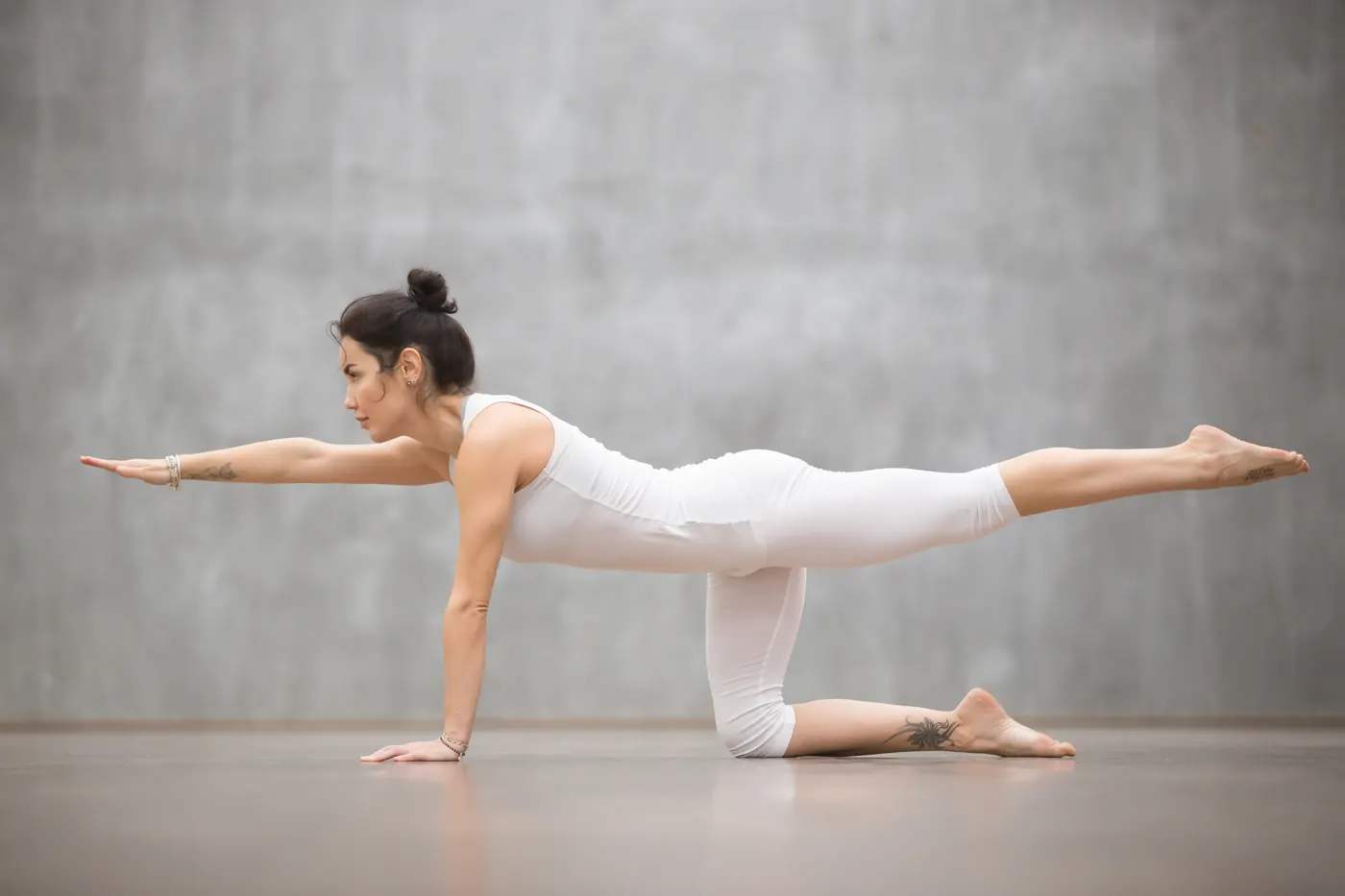
The bird dog is the dead bug flipped over: on hands and knees, opposite arm and leg reach long while the trunk holds a tabletop so level a glass of water would survive the set. It trains the same limbs-move-trunk-doesn't grammar with gravity now pulling the spine toward sag instead of arch.
Its reputation suffers from how it is usually performed — fast, wobbly, leg swung high. Done strictly it earns its place in serious back-care programming; done sloppily it is a stretch with ambitions.
What it trains
Anti-extension and anti-rotation together: the reaching limbs invite both the sag and the twist, and the trunk refuses both at once. The down-side hip and shoulder learn quiet stability; the reaching glute learns to extend the hip without recruiting the lower back.
Setup
- Quadruped: hands under shoulders, knees under hips, spine neutral — the tabletop.
- Exhale, set the ribs, and reach one arm forward and the opposite leg back — both long and low.
- Hips stay level as a countertop; the reaching foot goes back, not up.
- A beat at full reach, return with control, switch. Slow is the whole point.
The cues we use
- Reach long, not high
- Hips are a countertop — nothing tips
- Slow enough to feel the wobble and beat it
Common faults, and the fixes
| Fault | Why it happens | The fix |
|---|---|---|
| Leg swung above hip height | Range theatre — the lift comes from the arching back, not the glute | Foot reaches for the far wall at hip height; the glute does the extending, the spine stays out of it |
| Hips rotating open on the leg side | The anti-rotation half of the job losing | A light object balanced on the low back, or a coach's hand on each hip — feedback beats willpower |
| Racing through reps | Momentum hiding the wobble the exercise exists to train away | Three-second reaches with a pause — the tempo IS the exercise, same law as the whole anti-movement family |
The ladder
Easier: Single-limb versions — Arm-only or leg-only reaches until the opposite-pair coordination arrives — the dead bug's split-the-traffic logic, flipped over
Harder: Hands-and-toes bird dog and loaded carries — Knees hovering off the floor, or the skill graduated to standing work once strict reps are quiet
How it is loaded here
Tempo and precision are the load: slower reaches, longer pauses, a knee hover. External weight adds little the standards can't add first. When strict slow reps on both sides stay level and boring, the skill has transferred — spend it on carries and single-leg work.
When we swap it
- sore wrists in quadruped: Fists on the floor or a forearm-and-knee version — geometry, not abandonment
- knee discomfort kneeling: A folded mat under the knees, or the dead bug covering the same coordination face-up
Common questions
Why does this appear in back-pain programs?
It trains spine-stays-quiet-while-limbs-work at loads a sensitive back tolerates, which is why respected spine-care approaches feature it. For actual back pain, a clinician leads and we follow their green light.
It feels too easy — am I doing it wrong?
Almost certainly fast. Slow it to a three-second reach with a full pause, hips dead level, and the exercise reappears. Easy bird dogs are quick bird dogs.
How does this connect to lifting?
It is the quadruped rehearsal of the neutral-spine-under-work rule the hinge family bills for. Cheap practice here, expensive consequences there.