
The broad jump is a two-footed jump for distance: arms swing back as the hips load, arms throw forward as the hips extend, and both feet land together in a stuck quarter squat that you hold for a count. It trains horizontal hip power, the push that drives a skating stride, a ski turn and a trail climb, and it is the second plyometric we give people, after the jump squat has taught them to land quietly.
The dose is small and the standard is strict: a handful of reps per set, every landing stuck, and a walk back to the start line every time. The moment a set turns into a sequence of bounces, it has stopped being the exercise.
What it trains
Hip extension at speed. The take-off is a Romanian deadlift position leaving the ground: hips loaded back, then snapped forward, with the knees and ankles following. That is the same hip drive a hockey stride, a Cypress or Seymour ski turn and a steep push up the Grouse Grind all run on, which is why it shows up in the programs of skaters, skiers and trail runners here more than in anyone else's. The landing trains the hips and knees to absorb a forward-travelling body, which is the skill descending a trail depends on.
Setup
- Stand behind a line on the floor, feet hip width, arms relaxed.
- Swing the arms back as the hips push back and the knees bend, chest over the knees: it should look like the bottom of a Romanian deadlift with the arms behind you.
- Throw the arms forward and up as the hips drive through, and leave the floor with the whole body extended.
- Land on both feet at once, toes then heels, into a quarter squat with the hips back and the knees over the toes. Stick it and hold for a count of one.
- Stand, walk back to the line, and reset fully. Three to five reps per set.
The cues we use
- Arms back, then throw them at the far wall
- Hips lead the take-off; it is a hinge that leaves the ground
- Stick it: land, freeze, count one
Common faults, and the fixes
| Fault | Why it happens | The fix |
|---|---|---|
| Landing on straight legs or heels | The body is chasing distance and arrives at the landing with no bend left to absorb it, so the shock goes into the knees and lower back | Shorten the jump until the landing is silent and bent; distance comes back once the landing is owned |
| Stepping out of the landing | The jump has gone further than the person can stop, so a foot shoots forward to save the balance | Jump to the distance you can stick rather than the distance you can reach; a stuck jump that is half a metre shorter is the better rep |
| No arm swing | The arms freeze at the sides, and the jump loses both its rhythm and a good share of its distance | Rehearse the swing alone, back as the hips load and forward as they drive, and then add the jump |
| Knees caving on the landing | The hips are not controlling the feet, and the landing has arrived too narrow | Land a little wider than you took off and think knees out over the toes; the skater hop is the exercise that strengthens this fix |
| Jumping back to the line | It feels efficient and turns a power exercise into a fatigue exercise, with the tired landing that comes with it | Walk back, every rep, without exception; the walk is the rest |
The ladder
Easier: Jump squat — Until the vertical landing is quiet and consistent: the jump squat teaches the reset, the quarter-squat landing and the knee position without the forward travel that makes a broad jump harder to stop
Harder: Skater hop and single-leg bounds — When broad jumps are stuck cleanly at a consistent distance for a few weeks: the skater hop moves the same take-off and landing onto one leg and sideways, which is where the sports it serves actually happen
How it is loaded here
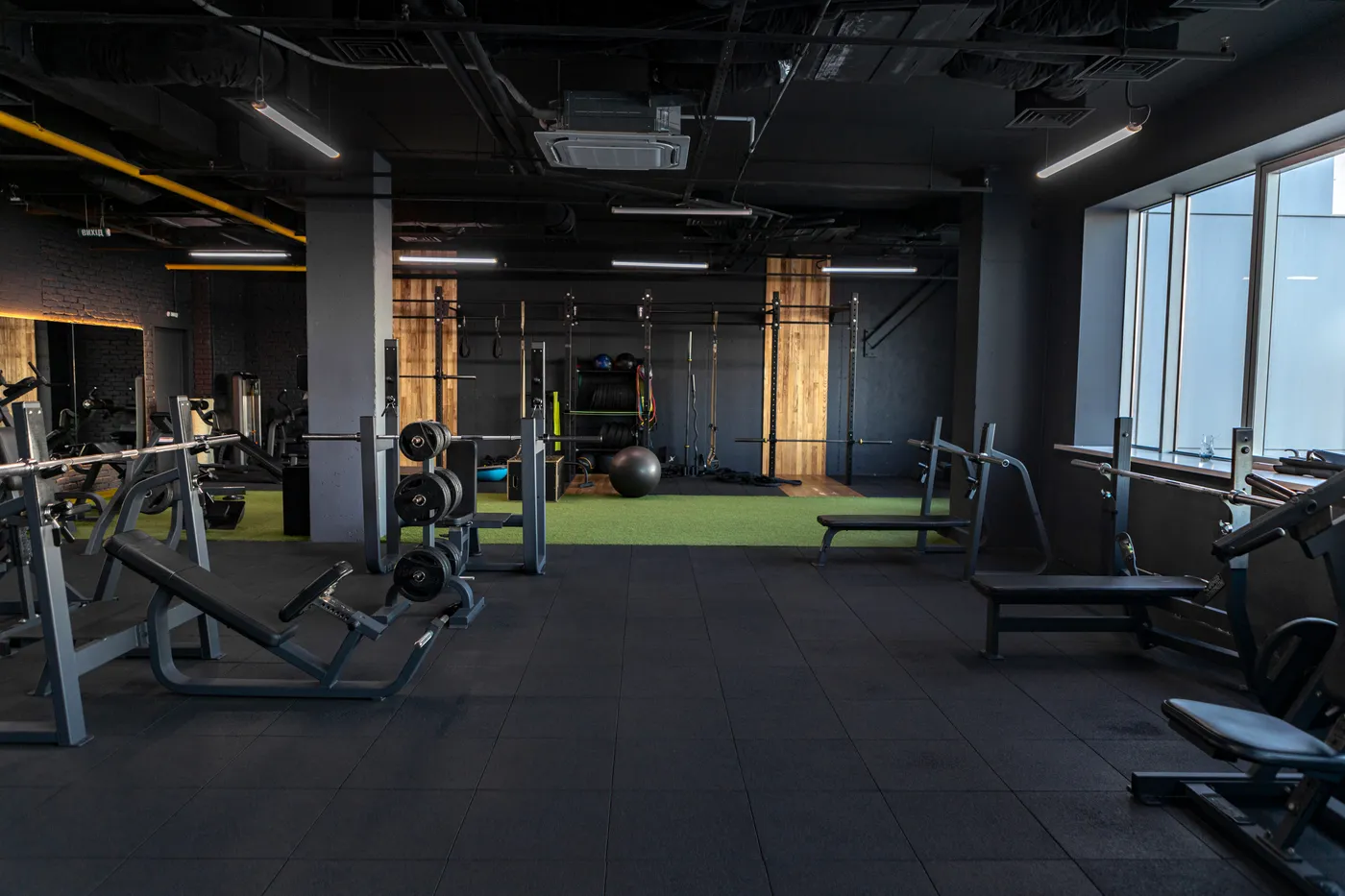
Bodyweight only, and distance is chosen by the landing rather than by the tape. We ask for a jump the person can stick every time, which for most people sits well short of their best effort, and we measure occasionally, with a plate on the floor as a marker, rather than every session. The dose is eight to fifteen contacts: three sets of three to five, a full walk-back and rest between reps, and a minute or two between sets. It lives early in the session on power days, once or twice a week, and never at the end. In a group of eight it needs a lane, so it runs along the length of the floor while other members are on the rig; when the floor is full it becomes a jump squat in place and nothing is lost.
When we swap it
- knees or Achilles tendons that dislike landings: The medicine ball slam and chest pass for power, and the cable pull-through done fast for the hip drive; both train the snap with nothing to absorb
- not yet able to stick a jump squat: Stay on the jump squat until it is quiet; there is no version of the broad jump that skips that step
- a joint or bone-density diagnosis, pregnancy or the months after it, or a recent lower-limb injury: Not ready for this one until your physician or physiotherapist says so; the power work in the meantime comes from throws and the treadmill hill
Common questions
Is there a target distance?
We do not chase a number, and we do not publish one. The distance that matters is the one you can stick on every rep with a bent, quiet landing; that distance climbs on its own as the take-off gets faster. A long jump with a stumbling landing is the rep we would rather not see.
Why walk back instead of jumping back?
Because the walk is the rest, and the exercise depends on every jump starting fresh. Jumping back doubles the contacts, halves the rest, and delivers the sloppy, tired landing that broad jumps are otherwise very good at avoiding.
How does a jump in a gym help a ski run or a shift on the ice?
Both sports are horizontal hip power and the ability to absorb a landing in a bent position, over and over. The gym version isolates that push and that landing, lets you practise them without a hill or a rink, and lets a coach see what your knees do when the force arrives. The strength work underneath it makes the push stronger; the broad jump makes it faster.