
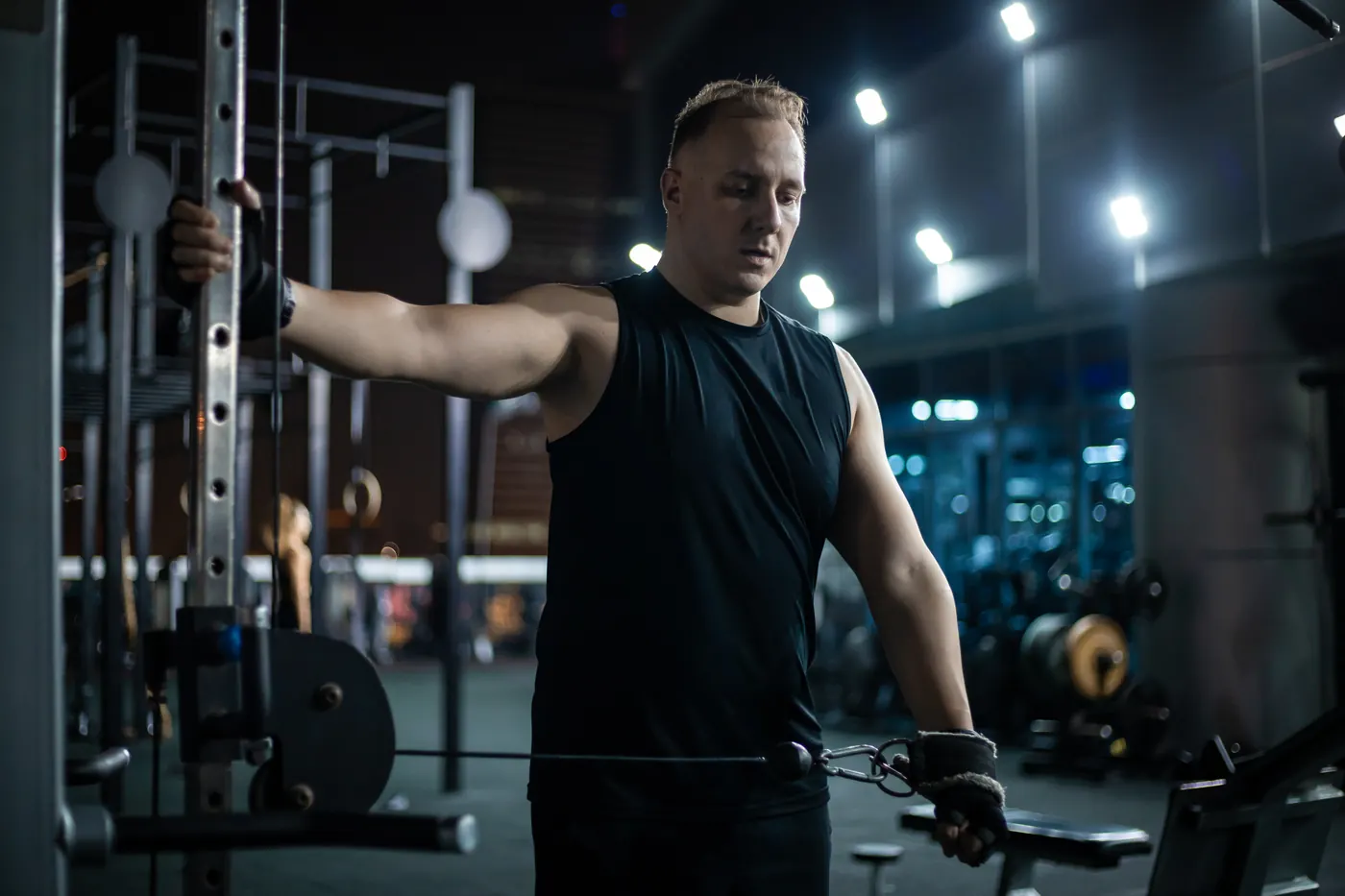
The lat pulldown is vertical pulling with a load dial: the chin-up's exact territory at any fraction of bodyweight the stack offers. That adjustability makes it both the chin-up ladder's engine room and a permanent volume tool for people who already own the bar.
Its rules are the chin-up's rules rehearsed seated: long hang, blades set, elbows driven down, bar to the collarbone — grammar that transfers rep for rep.
What it trains
Lats first and foremost, mid-back and biceps assisting, and the shoulder-blade control of pulling from overhead — the exact strength and sequencing a first chin-up is assembled from.
Setup
- Thighs snug under the pad, grip just outside shoulders on the bar.
- Long hang first — arms fully extended, blades reaching upward.
- Set the blades down, then drive the elbows toward the floor, bar to the collarbone.
- Return to the full hang under control — the stretch is half the rep.
The cues we use
- Elbows to the floor, not hands to the chest
- Chest meets the bar — proud, not leaning
- Full hang between reps
Common faults, and the fixes
| Fault | Why it happens | The fix |
|---|---|---|
| Leaning back and heaving | Bodyweight recruited to move a vanity stack | A slight fixed lean is fine; a rowing motion means the stack outran the lats — lighten and re-strict |
| Pulling behind the neck | Old folklore geometry shoulders dislike | To the collarbone in front, head neutral — the behind-neck version buys nothing and bills shoulders |
| Half hangs at the top | Stretch surrendered to keep tension comfortable | Full arm's-length reset every rep — the ladder's honesty depends on it |
The ladder
Easier: Straight-arm pulldown — For finding the lats at all before loading them — the feel-it-first drill
Harder: Chin-up — When strict pulldowns near bodyweight territory finish strong — the bar is the same movement with the dial removed
How it is loaded here
Climbs strictly, with the record noting stack relative to bodyweight — that ratio is the chin-up countdown, per the first-chin-up plan. Underhand grips run stronger than overhand; both are trained, logged separately, and neither excuses the heave.
When we swap it
- shoulders that dislike wide overhand pulling: Neutral or underhand grips — usually the whole fix, per the shoulder ladder
- no pulldown station free: Band-assisted hangs and straight-arm band work keep the vertical pattern fed
Common questions
Wide grip or narrow?
Just-outside-shoulders is the working default — extremes in either direction trade range and comfort for little. Variety is fine; strictness is the constant.
How does my pulldown number map to a chin-up?
Strict pulldowns approaching bodyweight put a first chin-up in scouting distance — negatives and band work close the remaining gap, per the ladder.
Why not just do assisted chin-ups instead?
Both serve: the pulldown's dial is finer-grained and queue-friendlier; assisted variations rehearse the actual bar. Programs here run whichever the room and the ladder stage favour.