
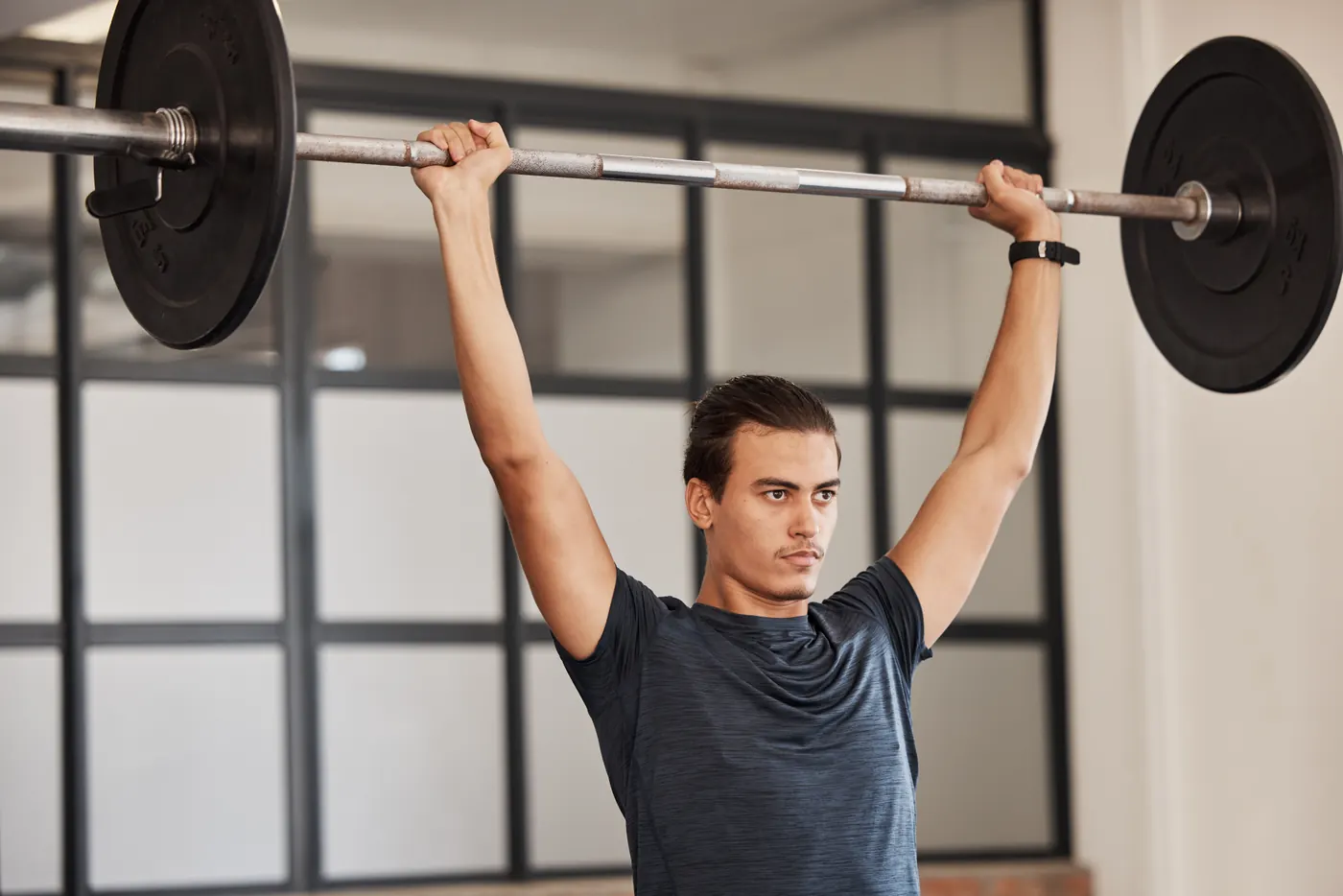
The overhead press sends a barbell from the shoulders to arms locked overhead — the push family's vertical summit, and the lift with the strictest entrance exam: going overhead demands shoulder and mid-back mobility that desk life quietly forecloses, so the movement is checked before it is loaded.
Passed and progressed, it is a superb builder of shoulders and pressing strength. Not yet passed, angled and landmine-style pressing buys the same strength while the range is rebuilt — a detour, not a demotion.
What it trains
Shoulders and triceps as the press, upper back finishing the lockout, and the whole trunk bracing against the arch the bar invites — a strict press is quietly a standing core exercise. Overhead competence itself pays into every reach, lift and carry above shoulder height that life sells.
Setup
- Bar at collarbone in the rack; grip just outside shoulders, forearms vertical under the bar.
- Elbows slightly forward, ribs down, glutes on — the pre-brace against the arch.
- Press up and slightly back around the face; head moves back, then through the window.
- Lockout: bar over mid-foot, arms straight, shrug tall at the top. Lower with the same path.
The cues we use
- Ribs down before the bar moves
- Head through the window at the top
- Squeeze the floor with your glutes
Common faults, and the fixes
| Fault | Why it happens | The fix |
|---|---|---|
| Lower back arching into a standing bench press | Missing overhead range borrowed from the spine | The ribs-down pre-brace, lighter loads — and if the arch persists, the mobility work and angled pressing detour |
| Bar drifting forward of mid-foot | Head never moved through — the press orbiting the face | The window cue: bar back over the base once past the forehead |
| Leg-drive creep | Knees bouncing to rescue a stalling strict press | Strict means strict — drop the load; push presses are a different, deliberately-programmed lift |
The ladder
Easier: Dumbbell shoulder press — Independent arms and rotatable grips make it the friendlier vertical press and the standard on-ramp
Harder: Load, on strict evidence — The slowest-moving number in the program by design — small jumps, patient blocks, and the record deciding
How it is loaded here
Expect humble numbers and slow growth — the overhead press uses small muscles honestly and rewards patience like nothing else. Loads move on strict, arch-free evidence; the classic error is chasing the lift's numbers with the lower back, which the ribs-down referee exists to prevent.
When we swap it
- overhead range not yet available: Angled pressing — high-incline dumbbell work and landmine-style paths — while mobility work rebuilds the window, per the bad-shoulder ladder
- any current shoulder complaint: Assessment first as always; pressing usually continues at friendlier angles rather than stopping
Common questions
Why is my overhead press so weak compared to everything else?
Because it is honest — small muscles, no angles to hide in, strict rules. Everyone's vertical numbers embarrass their horizontal ones; the ratio is normal.
Seated or standing?
Standing here — the bracing is half the value. Seated presses are a legitimate volume tool once the standing pattern exists.
Push press or strict press?
Strict builds the strength; push press borrows leg drive to train power on top of it. Learn strict first, meet the push press when programming calls for speed.