
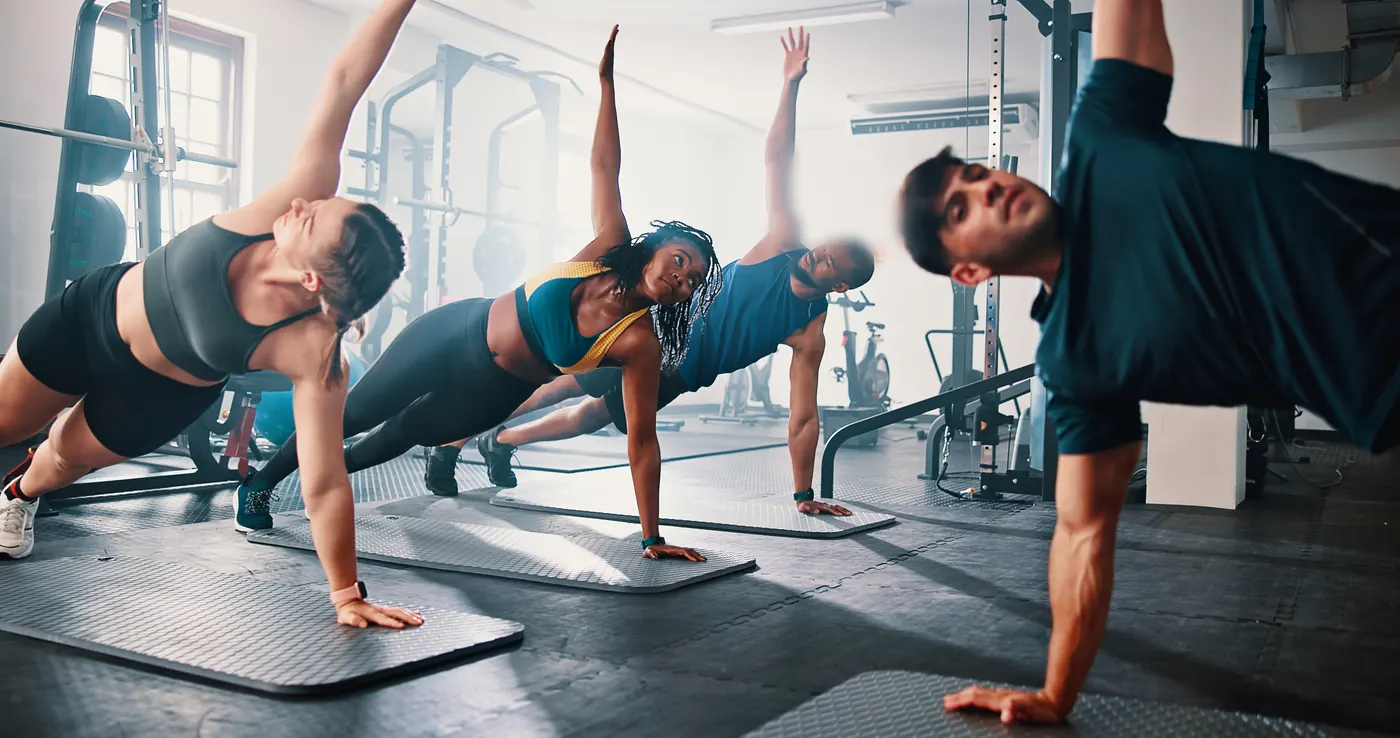
The side plank turns the trunk sideways to the argument: balanced on one forearm and the feet's edges, hips held high while gravity lobbies them floorward. It is the anti-lean family's isometric anchor — the same lateral-wall muscles the suitcase carry trains walking, held here in place.
It carries a quietly excellent back-health resume: the lateral trunk work it trains features in respected spine-care programs, which is why it appears early in returns and stays in programs indefinitely.
What it trains
The lateral trunk — obliques and the deep side wall — plus the bottom shoulder's stability and the hip's outer wall on the down side. The whole side-body chain from armpit to ankle learns to hold a line.
Setup
- Sidelying: elbow under shoulder, forearm across, feet stacked or staggered.
- Lift the hips until the body lines straight — head to heels, one plane.
- Squeeze the down-side waist toward the ceiling; shoulders and hips stacked vertically.
- Hold with continuous breath, then switch. Sides always travel in pairs.
The cues we use
- Hips high — proud, not sagging
- Stacked like books, not tipped
- Push the floor away with the forearm
Common faults, and the fixes
| Fault | Why it happens | The fix |
|---|---|---|
| Hips sinking mid-hold | The lateral wall's tension expiring quietly | The set ends at the first sink — shorter honest holds, the plank family's universal law |
| Rolling open toward the ceiling | The stack tipping to recruit the front body | The stacked cue and a wall-behind drill — heels, hips and shoulders brushing it |
| Hanging on the bottom shoulder | The joint doing what its muscles should | The push-the-floor cue — the shoulder actively long, never slumped into |
The ladder
Easier: Knee-down side plank — Bottom knee bent to the floor shortens the lever honestly — the standard entry, not a lesser exercise
Harder: Feet-elevated and lifted-limb versions — Top leg raised or feet on a low box once strict holds are boring — lever length is the dial
How it is loaded here
Progression by lever and density like its face-down sibling: longer lines, lifted limbs, harder squeezes before longer stopwatches. Sides logged separately — a side-to-side endurance gap is common, informative, and closed by leading with the weaker side.
When we swap it
- bottom-shoulder complaints: The knee-down version reduces the load, and the suitcase carry trains the same wall standing — per the shoulder ladder's spirit
- wrist or elbow discomfort: Padding under the forearm or the straight-arm version, whichever geometry agrees
Common questions
Why is one side so much weaker?
Asymmetry is the norm and the finding — the same audit logic as every unilateral page. Lead weak, match strong, watch the gap close across a block.
Side plank or suitcase carry?
Same muscles, different formats: the hold teaches the position, the carry spends it walking. Programs here run both — the pairing is deliberate.
Should my top arm do anything?
Resting on the hip or reaching skyward are both fine — the reach adds a balance garnish. The work lives in the down-side wall either way.