
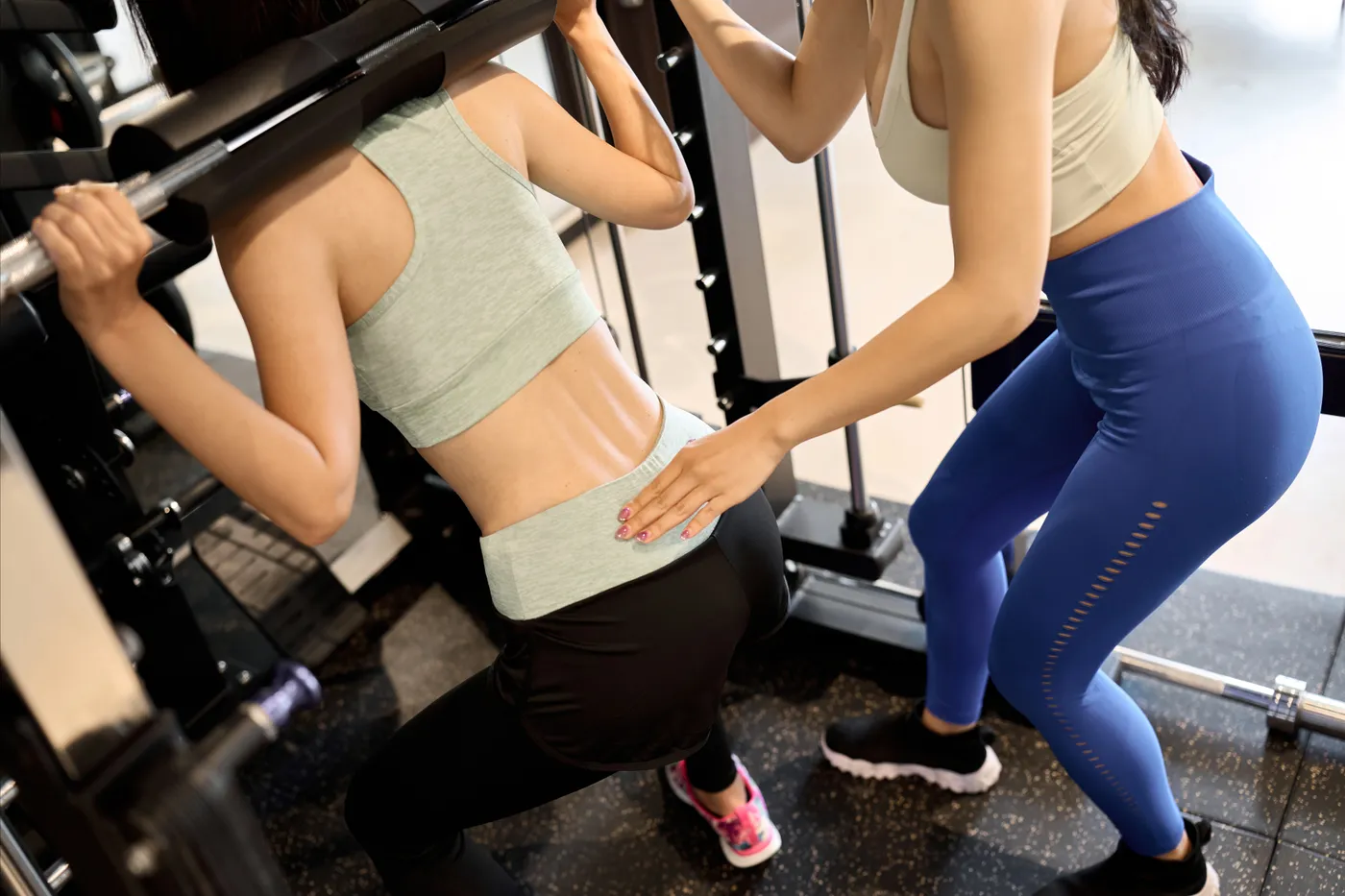
Unilateral training is loading one limb at a time (split squats, single-arm rows, suitcase carries) instead of both together. It exposes the side-to-side differences two-limb lifts hide, spares the spine because the loads are smaller, and transfers to sports that happen one leg at a time.
Unilateral training asks each side to do its own work and report separately. A back squat lets a strong right leg quietly carry a weaker left one; a split squat cannot. That honesty is the point: the weaker side gets found and trained, and the two converge over a block.
It does not replace the big two-limb lifts; it is the second lower-body movement of most sessions and the one that pays off most obviously outside the gym.
The split squat that told on a hip
A member's back squat looks symmetrical from the front. First set of split squats: the right leg gives ten clean reps, the left gives seven and a wobble. Nobody was hiding anything; the bilateral lift never asked. The fix is a rule, not a diagnosis: start each set with the weaker side, match the strong side's reps to it, and give the weak side an extra set for a block. Within weeks the reps converge and the back squat improves without being touched.
| Two-limb lift | One-limb cousin | What it exposes |
|---|---|---|
| Back squat | Split squat | Which hip and knee are doing the work |
| Romanian deadlift | Single-leg RDL | Hamstring balance and a foot that cannot hold still |
| Barbell row | Single-arm dumbbell row | A trunk that rotates to help the weak arm |
| Farmer carry | Suitcase carry | A side of the trunk that leans instead of holds |
The confusion: it is not balance training, and it does not replace the barbell
The wobble is a by-product, not the goal. Unilateral work is strength work with real load: a split squat holding dumbbells heavier than you would like is the exercise; a bodyweight lunge on a foam pad is something else. The second confusion runs the other way: single-leg work is fashionable, so people drop the two-limb lifts and lose the highest loads their body can learn to tolerate. The barbell builds the ceiling; single-leg work makes sure both legs can reach it.
Alternating lunges are unilateral rep by rep, but all reps on one side before switching is the honest version: it lets one side get tired on its own.
Where it sits in a session, and why it transfers on the North Shore
In semi-private personal training it is usually the second lower-body movement, after the main squat or hinge, and the suitcase carry often closes the session. The transfer is direct: the walk down from Quarry Rock is hundreds of single-leg landings, a ski turn loads one leg while the other steadies, a skating stride is a one-leg push and a one-leg catch. Nothing on the mountain or the ice happens on two feet at once.
Common questions
Should my two sides ever be perfectly equal?
No, and chasing it wastes a block. A small, stable difference is normal; one that grows or comes with pain is worth a coach's attention.
Can unilateral work be my main lower-body lift?
For a while, and for some people permanently: those training around a back that dislikes heavy bilateral loading, or rebuilding a knee under a physiotherapist's plan. For most it is the second movement, because barbell lifts build strength faster.
Does unilateral training help a bad back or aggravate it?
Usually helps: the same leg stimulus arrives with a fraction of the spinal load, and a suitcase carry trains the trunk to resist leaning, which is what a back wants. Anything that hurts is a stop-and-ask, not a push-through.