Training with your partner is a good idea more often than not — a built-in accountability partner who shares your fridge and your calendar is powerful adherence machinery. It goes wrong in two predictable ways: pace mismatch (one of you is fitter, so someone ends up bored or buried) and goal merging (two different bodies shoehorned into one program). Both problems have clean solutions.
The accountability upside is real
A partner converts training from private intention into shared plan. Cancelling now requires a conversation, not just a silent snooze; the weekly schedule negotiates itself over dinner; and you each gain a witness to progress that would otherwise go unremarked. Habits shared with a household member are simply harder to drop — the environment itself enforces them.
There's a quieter benefit underneath the logistics: shared vocabulary. When both of you know what a hard training week costs and gives, the household starts protecting sessions the way it protects other things that matter — and that protection outperforms any pep talk.
Pace mismatch is normal; scaling solves it
Assume from the start that you're at different levels — nearly every couple is. The fix isn't training apart; it's choosing a format where difficulty is individual. In station-based coached sessions the circuit is shared but the loads, speeds and variations aren't: one of you pushes the treadmill harder, the other lifts lighter, and the clock treats you identically. Nobody waits, nobody drowns.
This is exactly where circuit-style classes outperform sharing a barbell at a conventional gym, where mismatched strength means constant plate-swapping and one person always pacing the other.
Shared sessions, separate goals
Attend together; program apart. One of you may be chasing strength while the other rebuilds conditioning after years away — merging those into a single compromise plan serves neither. Let a coach hold each agenda individually inside the same time slot.
One more rule that saves relationships: don't coach each other. Corrections from a partner land as criticism even when they're right; corrections from a coach land as coaching. Outsource that friction.
Separate goals also mean separate timelines. One of you will hit a milestone first, and that's a scheduling fact, not a scoreboard — celebrate it and keep moving.
The logistics that make it easy
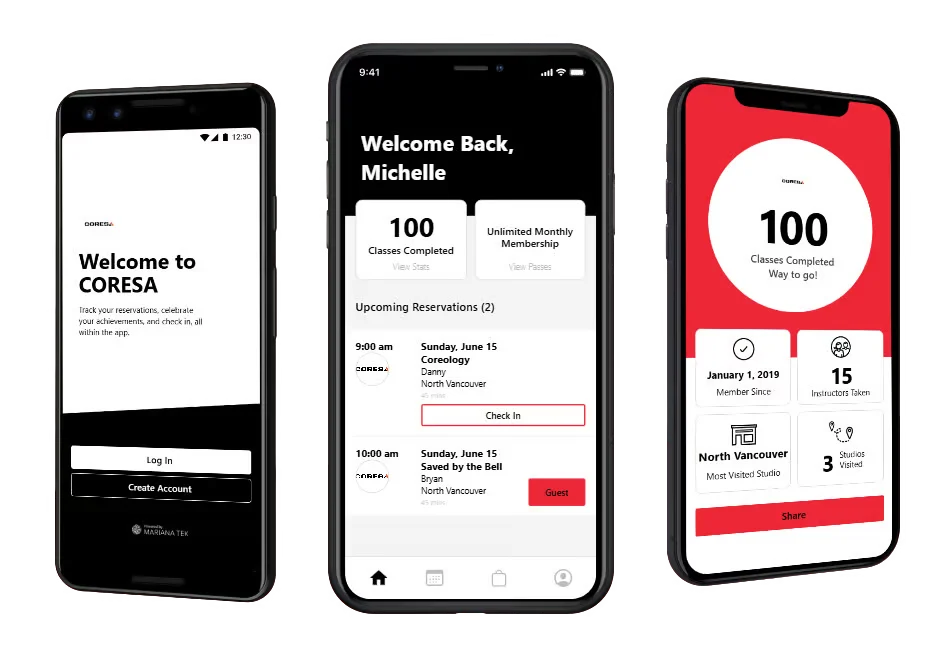
Practically, couples do best reserving the same recurring sessions — small-group personal training suits pairs especially well, since the coaching stays individual while the booking is shared. Lock spots in together through the Coresa app.
And if you're still evaluating studios, tour as a pair: you'll each notice different things, and you both have to actually want to come back to the room. If one partner is brand new to training, consider giving them a solo visit or two first — arriving with a small base of familiarity evens the early emotional footing.
Common questions
What if my partner is way fitter than me?
Expected, and solved by design: in scaled, station-based sessions you share the room and the clock while working at entirely separate intensities. The gap stops mattering the moment difficulty becomes individual rather than shared.
Do couples get a shared membership rate?
Membership structures and pricing are operational details not worth guessing at — ask the team directly on a consult call or by phone at (236) 868-9964, and you'll get current answers instead of internet folklore.
What if one of us loves it and the other wants to quit?
Let the structure absorb it rather than the relationship: the keen one continues, and the reluctant one renegotiates format or frequency with a coach instead of abandoning everything. A shared start doesn't obligate a shared forever.
Is it better to train at the same time or separately?
Whatever your childcare, commute and energy patterns support — the adherence benefit comes mostly from mutual expectation, which survives attending different time slots. Same-session training adds fun and simpler logistics when calendars allow it.