Fitness classes don't just work for beginners — they're arguably built for them. The workout on the whiteboard is a template, not a mandate: coaches adjust it person by person through four dials — the load you lift, the range you move through, the tempo you work at, and the exercise itself. A first-timer and a five-year regular can share the same station and both leave properly trained.
What makes this hard to believe from the outside is that the adjustments are nearly invisible. Here's how the dials work, why you won't be the only one using them, and how to pick sessions that make the on-ramp gentler.
The four dials: load, range, tempo, swap
| Dial | What it changes | What it looks like in the room |
|---|---|---|
| Load | How heavy the resistance is | Reaching for the lighter pair on the rack — nobody logs who lifted what |
| Range | How far the movement travels | Squatting to a box, pressing from an incline instead of the floor |
| Tempo | How fast you work | Controlled reps at your own rhythm instead of racing the clock |
| Swap | The exercise itself | Step-ups where the plan says jumps, brisk marching where it says sprints |
None of these change what the session trains — a hinge is still a hinge at half the weight, a push is still a push from an incline. They change the dose, which is exactly the thing a beginner needs adjusted.
The open secret: scaling never stops
Watch any experienced room closely and you'll spot the dials in constant use — the runner protecting a cranky knee on jump day, the regular easing off after a brutal week of sleep, the member working carefully around a shoulder. Modification is the normal operating mode of a coached class at every level, which is why choosing an easier version marks you out far less than you'd expect. And if the real worry is the feeling of walking through the door rather than the mechanics inside it, first-class nerves get their own honest answer.
Why beginners often improve faster in a class than alone
Early progress comes disproportionately from two things — learning movements well and showing up repeatedly — and classes industrialize both. A coach corrects your technique in the weeks before bad habits set, and the structure deletes every decision that stalls new gym-goers: what to do, in what order, for how long. A booked spot also gets you through the door on days when motivation doesn't.
There's a physiological tailwind too. Untrained bodies respond to almost any sensible, consistent stimulus, so the varied work of a coached session lands squarely on that window. The gains beginners chase rarely require a perfect program — they require a decent one, done.
Choosing your on-ramp
Some sessions make easier entries than others. Quieter time slots tend to run with fewer people, which means more coach attention landing on you; lower-impact formats spare joints that aren't conditioned yet; and a steadier session beats the flagship high-intensity one for your first month. Asking a studio which slots suit newcomers is a completely routine question.
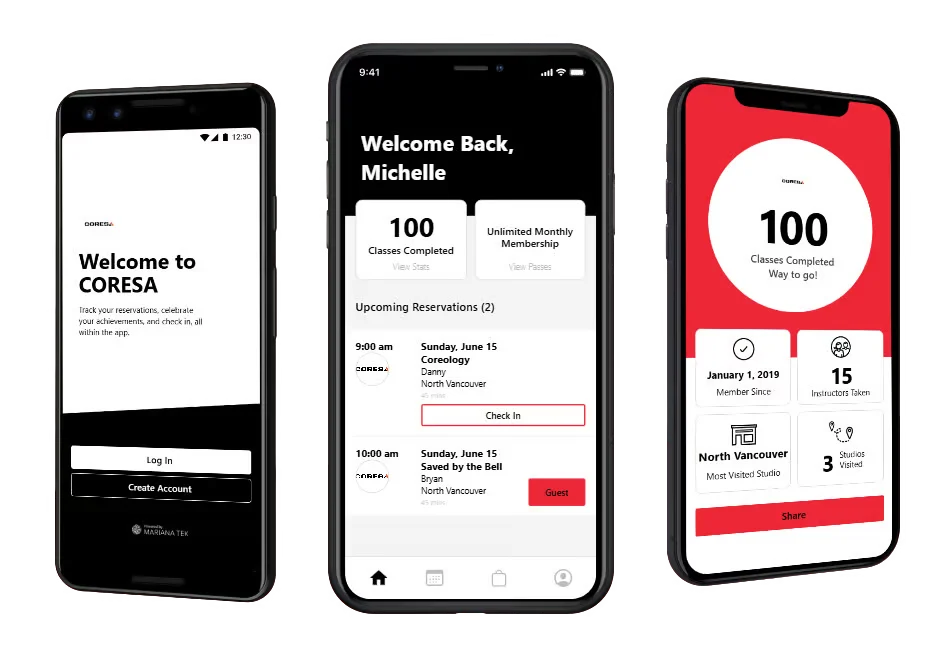
When you're ready to pick a time, the Coresa app shows what's running each day, and the first-class walkthrough covers the practical sequence from the front door to the cooldown.
Common questions
How out of shape is too out of shape for a class?
There's no fitness bar to clear — the dials exist precisely so the session meets your current capacity. If you have a medical condition or a long layoff, a quick word with your doctor and then with the coach covers it, and a free 15-minute consult call is a zero-stakes way to gauge fit first.
How many classes a week should a beginner start with?
Two is a strong start — enough to build the habit while your body adapts between visits. Add a third once post-class soreness settles into a predictable pattern, which for most people takes a few weeks.
Will I slow everyone else down?
No — the format won't let you. Stations run on a shared timer, so the room starts and finishes together no matter how many reps anyone completes. Your pace shapes your workout and nobody else's.
How long until classes produce visible results?
Energy and coordination shift within the first few weeks; strength and endurance markers follow over the next couple of months of consistent attendance. Bodies change on a slower clock than habits do, so judge your first month by attendance rather than the mirror.