
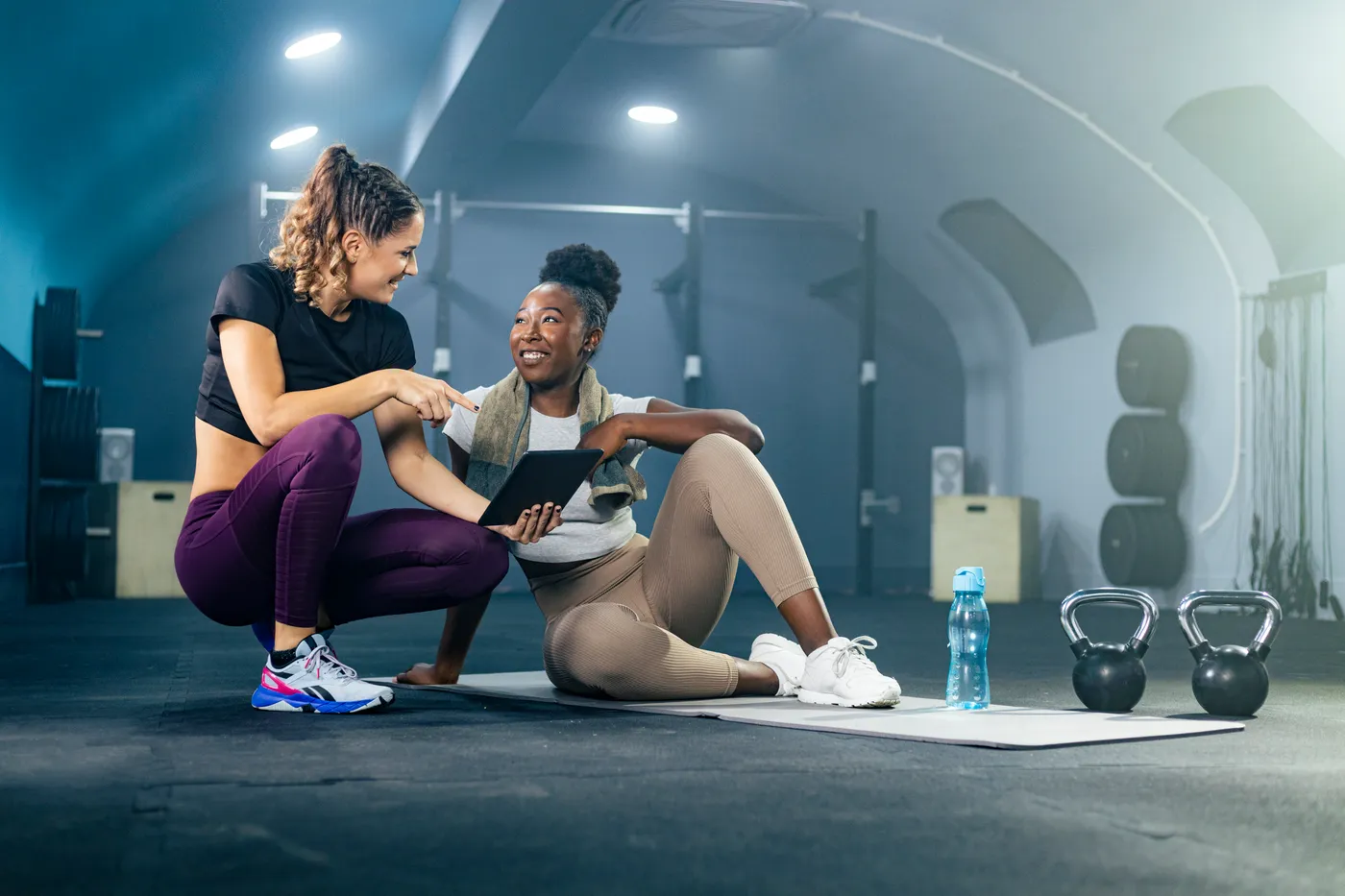
An in-home personal trainer removes the commute, the room full of strangers, and every excuse involving the word "there." A studio removes the equipment ceiling, the household interruptions, and the quiet awkwardness of squatting beside your own couch. Both are personal training; the venue changes more than people expect.
North Vancouver has trainers who travel and studios that do not, so this is a live local choice. Here is the honest version of it.
The trade, laid flat
| In-home trainer | Training studio | |
|---|---|---|
| Commute | Zero — the strongest card in the deck | Yours to make, every session |
| Equipment | What fits in a car and your spare room | Racks, bars, full dumbbell runs, machines, treadmills |
| Progression ceiling | Real: loading heavy lower-body work at home is hard | Effectively none for general training |
| Environment | Familiar, private, occasionally chaotic | Purpose-built, no interruptions, other humans |
| Cost | Often premium — travel time is billed somewhere | Standard rates; small group formats cut them further |
| Habit-building | Fragile to household life | Anchored to a place whose only purpose is training |
Who in-home genuinely suits
- People for whom leaving the house is the barrier — new parents in the nap window, carers, mobility-limited clients, the profoundly gym-averse.
- Beginnings. A private on-ramp at home can be the bridge that makes a studio possible in month three.
- Well-equipped home gyms. If your garage already has a rack and bar, the ceiling argument mostly dissolves.
For these situations, in-home is not a compromise — it is the only version of training that will actually happen, which makes it the best version by definition.
Where the studio pulls ahead
Equipment decides progression: strength work eventually needs loads that do not live in a duffel bag, and the home version of leg training in particular runs out of road early. Environment decides focus: a room with one purpose beats a living room negotiating with a doorbell. And the habit science quietly favours the commute it seems to punish — a place you go becomes a cue, and arriving is half the session's psychology.
The studio also changes the economics: in-home is necessarily one-on-one, while a studio can split a coach across a capped group. At Coresa that is semi-private personal training — individual programming at a lower per-session cost than private pricing, which no travelling trainer can structurally offer.
The hybrid and the verdict
The common middle path: coached sessions at a studio, plus short written homework for the days between — which is what our workouts library exists for. It captures the studio's equipment and progression with home's convenience on the light days.
Verdict by situation, not by category: if leaving the house is the genuine barrier, hire the travelling trainer and never apologize. If the barrier is anything else — motivation, knowledge, structure — the studio solves those with a higher ceiling and usually a lower price. We are, obviously, the second thing: we do not travel, and that answer explains why without pretending home training does not work.
Common questions
Is an in-home trainer more expensive than a studio?
Usually per hour, once travel is priced in, and always relative to small group formats — splitting a coach across a capped group is the structural discount home sessions cannot offer.
Can I get properly strong with home equipment?
Upper body and general fitness, largely yes with dumbbells and bands. Lower-body strength beyond the beginner phase wants loads that are awkward at home — it is the honest ceiling of the format.
What about online coaching instead?
A different trade again: programming without eyes on your technique in the moment. The comparison lives in our online-versus-in-person answer; beginners need the eyes more than they think.