
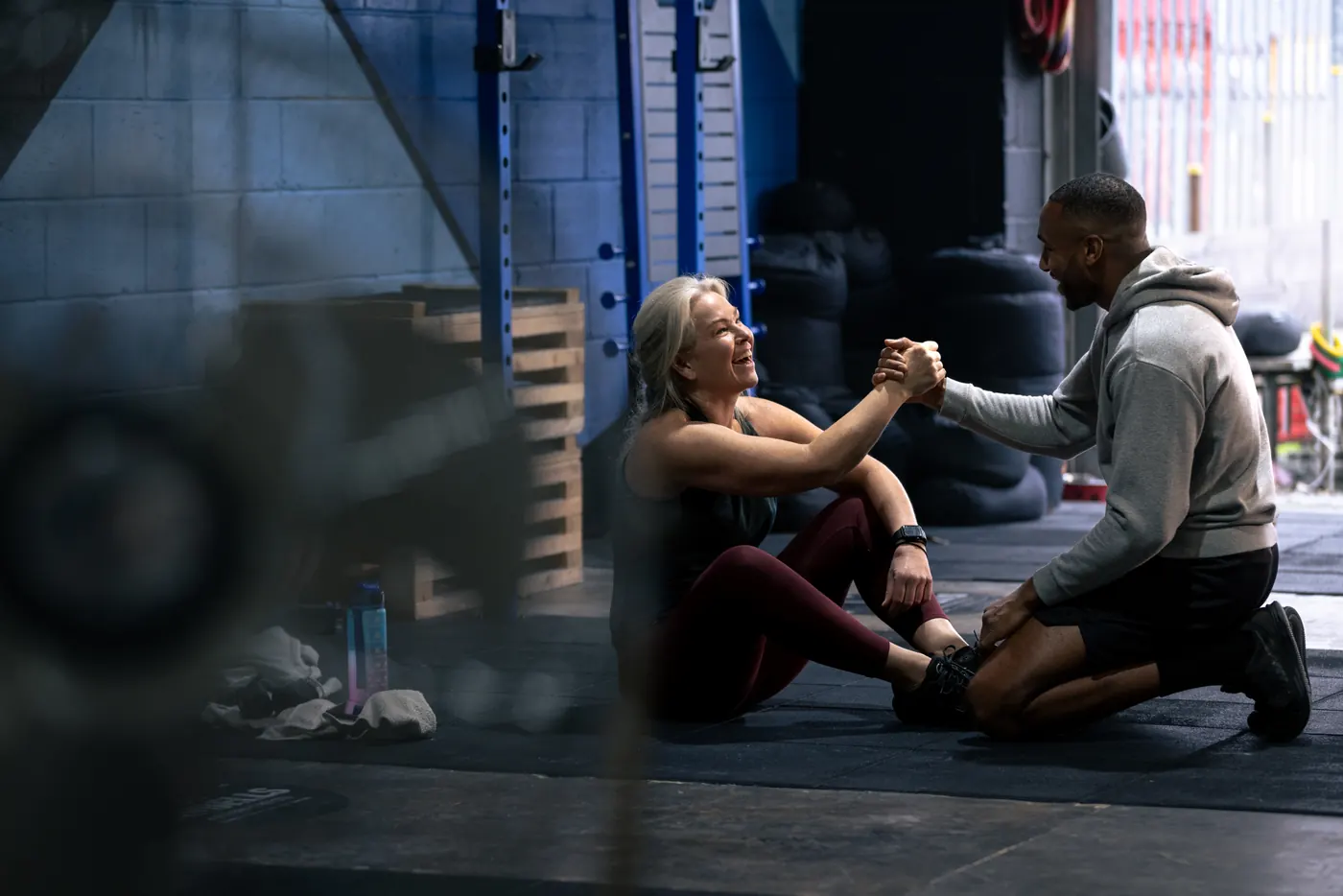
Semi-private personal training is one coach working with two to four people at once, each following their own program rather than a shared workout. You get individual programming and most of a coach's attention; what you give up is exclusivity, and in exchange the hour costs less than private coaching.
The term is not standardized across the industry, which is where most of the confusion comes from. Some studios use it for two people, some for four, and some use it interchangeably with small group training. The number in the room is what actually matters, so ask for it directly.
Where semi-private sits on the spectrum
Coached training runs along one axis: how many people share the coach. Everything else — programming quality, atmosphere, price — follows from that number.
| Format | People per coach | Whose program |
|---|---|---|
| 1-on-1 personal training | 1 | Yours, entirely |
| Partner or duo training | 2 | Usually two individual programs run in parallel |
| Semi-private | 2 to 4 | Individual programs, coached simultaneously |
| Small group training | Roughly 5 to 8 | Individual loads inside a shared session structure |
| Group class | 10 and up | One workout for the room, scaled in the moment |
The line between semi-private and small group is genuinely blurry, and honest studios will admit it. Past about eight people, though, individual programming stops being deliverable no matter what the format is called — which is why the number in the room is the question worth asking on any tour.
What you actually get for the money
Semi-private exists because a coach's hour is the expensive ingredient in any session, and splitting it three ways makes serious coaching affordable to people who would otherwise train alone.
What survives the split: your own program, your own loads, technique correction while you are moving, and a coach who tracks your progress between sessions. What thins out: the running commentary. In a private session your coach is watching you constantly; with three people they are cycling between you, which means some sets go unwatched.
For most goals that is a good trade. The sets that need eyes on them are the heavy ones and the new ones, and a competent coach is standing next to those. The third set of a movement you have done for eight weeks does not need supervision.
Where it stops being a good trade is when you need continuous attention — rebuilding technique from scratch, working through a delicate injury history, or preparing for something with a hard deadline.
Does Coresa run semi-private sessions?
Yes. Since October 2026 Coresa offers personal training only, delivered two ways: 1-on-1 and semi-private. Semi-private here means one coach shared by a few people, each on their own program and loads. Small group training in larger groups is no longer offered.
In practice, semi-private is what most people searching for the term are after: a coach who prepares your session before you arrive, chooses your loads and progresses your program, delivered in a room small enough for that to be real, at a lower per-session cost than private time.
If what you want is specifically to train alongside one other person, that works too: book semi-private together and the coach scales each of you individually; training with a friend covers how to set that up.
Questions that get you a straight answer anywhere
Since the label means different things at different studios, judge the product rather than the word. Five questions do it:
- How many people are in a session, at maximum — not on average?
- Do we each follow our own program, or one shared workout with different weights?
- Who chooses my load, and how does it change over time?
- Is my progress recorded anywhere I can see?
- What happens if only one other person books — does the session still run?
The answers to one and two separate genuine semi-private coaching from a small class with a nicer name. If a studio cannot give you a maximum, that is the answer.
Common questions
Is semi-private the same as small group training?
Nearly, and the terms overlap. Semi-private usually implies two to four people on individual programs; small group usually implies five to eight inside a shared session structure. Ask for the cap rather than trusting the label.
Is it as effective as 1-on-1?
For general strength and fitness goals, yes for most people — the things that drive results are programming, supervised effort and turning up consistently, and all three survive a small split. Private coaching wins where undivided attention is the actual requirement.
Can I bring a friend and make it semi-private?
At most studios, yes. At Coresa you book semi-private sessions together; you train side by side and the coach scales each of you separately, so a fitness gap between you is irrelevant.
Is semi-private cheaper than private coaching?
Almost always, because the coach's hour is shared rather than exclusive. How much cheaper depends on the studio, the session length and the package — ask on a consult rather than trusting a published average.
What if the other people are much fitter than me?
It changes nothing, because you are not doing their workout. Different loads, sometimes different exercises, same room. This is the part people worry about most and notice least once they have trained a few times.