
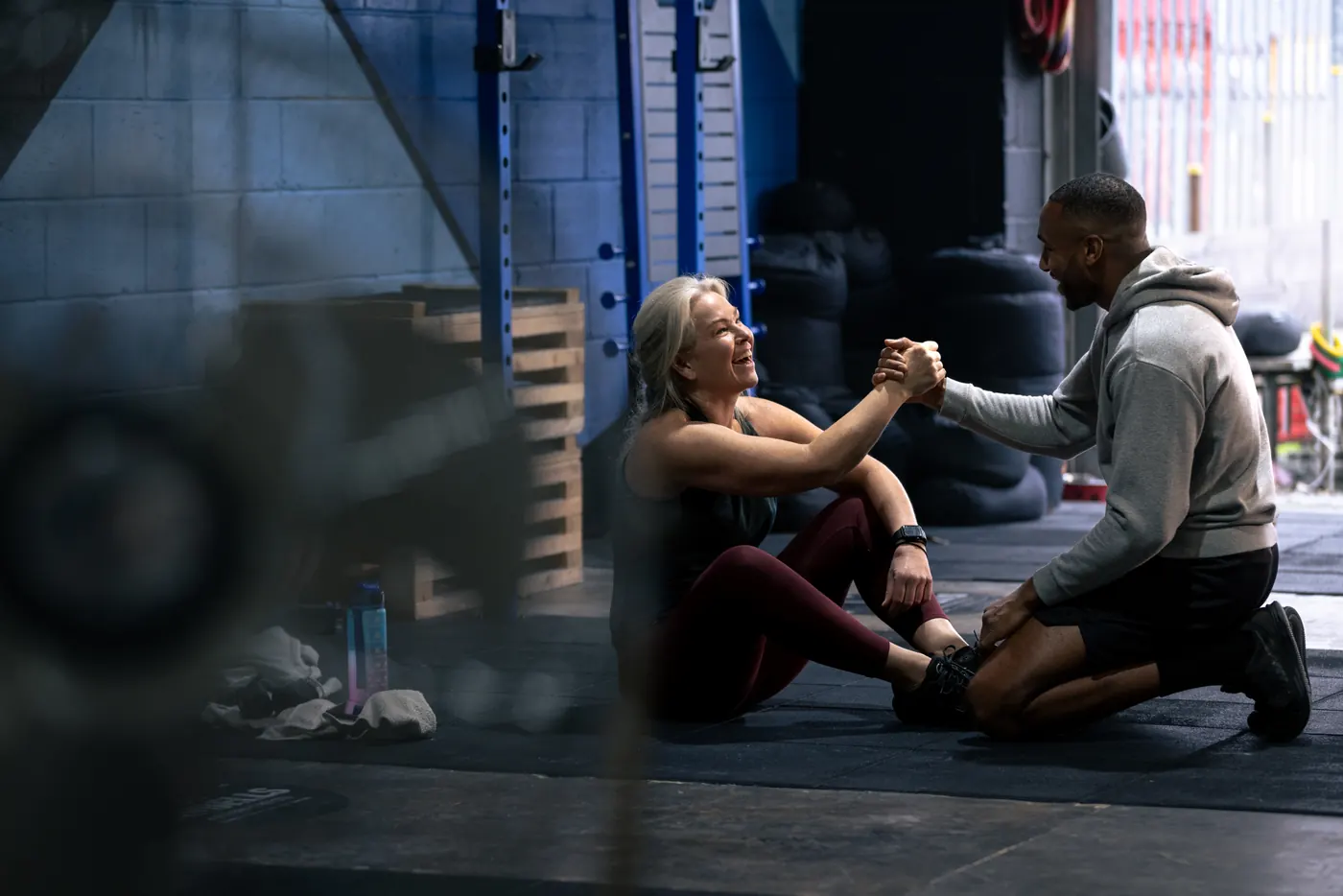
Move when the private hour has become mostly supervision: your squat, hinge, push, pull and carry hold their shape without a cue, you pick loads within a rep or two of what the coach would have chosen, and your log shows the same sessions happening week after week. For most people who start in 1-on-1 that point arrives somewhere in the second to fourth training block, not on a calendar date. Small group training then gives you the same individual programming with a coach in the room, and 1-on-1 stays available for the specific blocks that need it.
This page is about the switch between the two coached formats. Training with no coach at all is a different question, covered in how long until you can train without a coach.
The four graduation signals
Coaches look for four things before suggesting the move, and they are visible on the floor and in the log rather than felt.
- Stable patterns without cues. The goblet squat, the Romanian deadlift, a press, a row and a carry all look the same on set three as on set one, and the coach has stopped saying anything during them.
- Load selection within a rep or two. Asked what weight to use, you name one that leaves about two reps in reserve. You are no longer guessing low to be safe or high to impress.
- A consistent log. Twelve weeks of booked sessions that happened, with loads recorded, is the evidence that the habit survives without a private appointment holding it up.
- The hour has become supervision. The coach is watching rather than teaching. When you notice that, you are paying for attention you no longer need.
A fifth, quieter signal: you have stopped asking whether a rep was right, because you can feel when it was.
What changes on the floor, and what does not
| 1-on-1 | Small group (up to eight) | |
|---|---|---|
| Your program | Individual, built from an assessment | Still individual, prepared before the session |
| Loads | Chosen with you in the moment | Written on your sheet, adjusted as the coach rotates |
| Cueing | Continuous | At the moments it matters |
| Pace | Entirely yours | The room's clock, your own stations |
| Booking | Your appointment | A session on the live schedule or the app |
The thing people fear losing, individual programming, is the thing that does not change. What changes is the density of attention, and by the time the signals above are true, the extra density was mostly being spent on watching you do things correctly.
The reverse move: back to 1-on-1 for a block
The switch is not one-way. Members go back to private hours for a defined block, then return to the group. The usual reasons:
- After an injury. A physiotherapist's clearance comes with a list of things to rebuild carefully, and a rebuild block is easier one-on-one.
- Before an event. A Grouse Grind time, a ski trip, a fitness test for a job: a few private sessions sharpen the specific work.
- Learning a new lift. Moving from goblet squat to front squat, chasing a first chin-up, or picking up a Turkish get-up goes faster with an hour of undivided eyes.
The word block matters. It has an end date, and the group session is where you return.
The hybrid many members keep
A common long-term shape is group sessions for volume plus one private hour per block, or per month, as a technique audit and program review. It costs a fraction of an all-private schedule and keeps a second set of eyes on drift. The full comparison lays out attention and cost side by side.
How the switch happens here
Say it to the coach or on a consult. The record from your 1-on-1 program travels with you, and your first small group block is written from it, so nothing is relearned. Group sessions are booked individually on the live schedule or the Coresa app, and how memberships and 1-on-1 packages are structured is a consult question.
Signs you moved too early are easy to spot: guessing loads, form drifting by station three, waiting for the coach to come round before starting a set. The fix is a short private block, not a permanent return.
Common questions
Does my program change when I move to the group?
The structure does not; the delivery does. You keep individual patterns, loads and progression, written before the session rather than decided in the moment. If you were doing something unusual in 1-on-1, the coach adapts it to the equipment and clock of a group hour.
Is there a minimum number of 1-on-1 sessions before I can join the group?
No. Many people start directly in small group training, which has an on-ramp built in. Starting in 1-on-1 is for people who want an assessment-first start or have something specific to rebuild.
What happens to the notes from my private sessions?
They become the first page of your group record. Loads, swaps, cues that worked and anything the physiotherapist said all carry across.
Can I return to 1-on-1 for a short block?
Yes, as a block with a purpose and an end date. How short blocks are packaged is a consult question; call (236) 868-9964 or ask at the studio.
What if I move and the group feels too fast?
Say so at the first session. The coach slows your stations, not the room, because loads and pace are individual. If it still feels wrong after two weeks, a short private block closes the gap.