
Every studio says it coaches. The word covers everything from a professional who has planned your session before you arrived to someone counting your reps out loud while looking at their phone. So it is worth being specific about what we mean by it.
Four principles decide what happens on our floor. They are unglamorous, they are not a philosophy so much as a set of operating rules, and they are the difference between a room where people train and a room where people get coached.
One: the session exists before you do
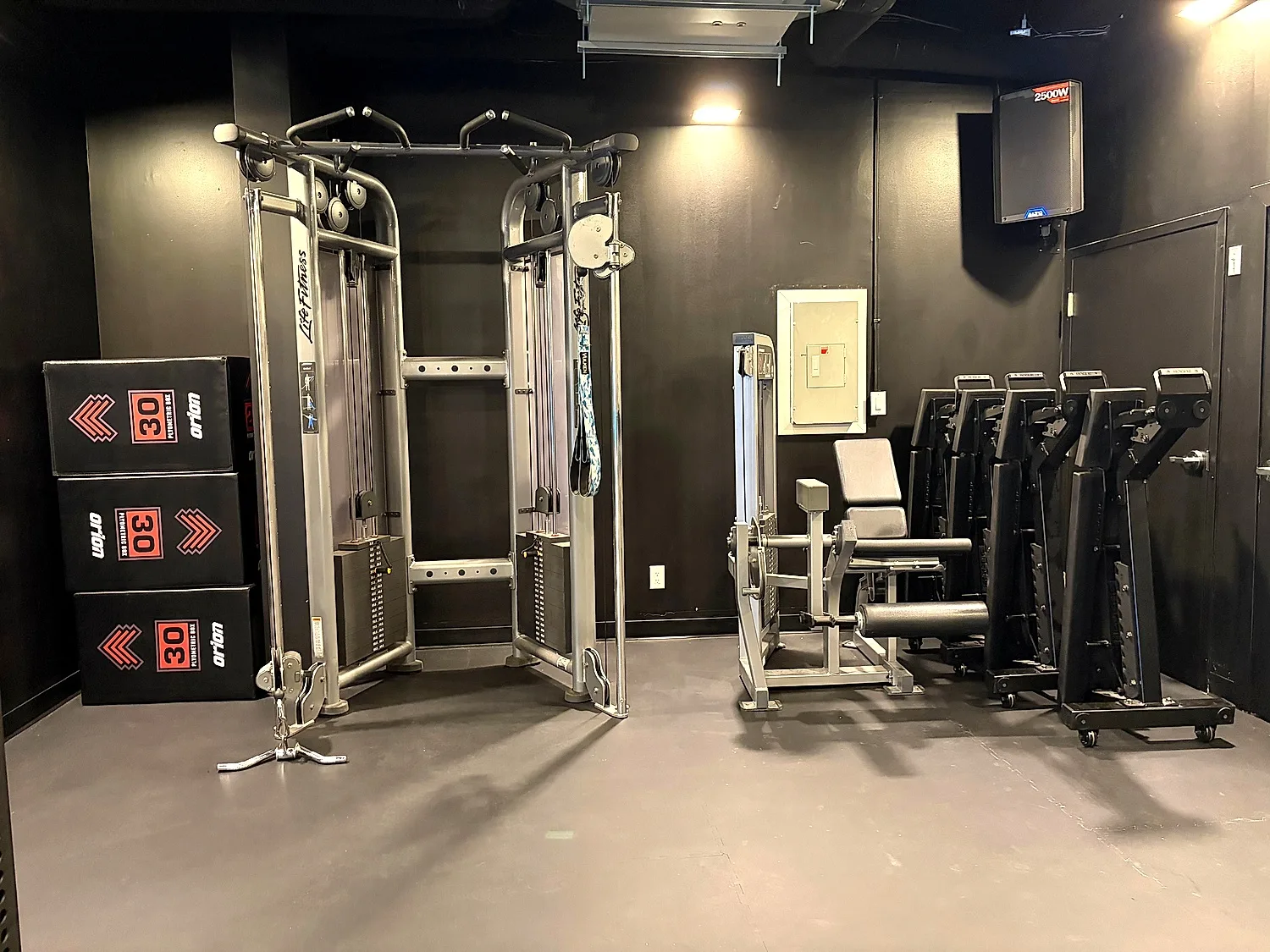
Your station is set up and your starting loads are chosen before you walk through the door. That is the first principle and it sounds administrative until you consider the alternative.
The alternative is a room where everyone arrives, waits to be told what is happening, then negotiates for equipment. Ten minutes of a session disappears into logistics, and — worse — the load you end up using is whatever was already on the bar.
Preparation is also what makes a shared session coachable. A coach who spent the morning deciding what each of eight people is doing has already done the thinking that would otherwise have to happen live, badly, in front of everyone.
Two: the coach picks the weight
Left to ourselves, almost all of us pick the weight we used last time. It feels appropriate, it is definitely achievable, and it is the single most common reason people train for years without getting stronger.
A prescribed load solves this because the decision is made by someone with a record and no emotional attachment to yesterday. It also solves the opposite failure — the person who goes too heavy every session, buries their technique, and spends more time managing niggles than progressing.
The rule we work to is straightforward: the last rep of a set should look like the first. If it does, and there was clearly more in the tank, the weight goes up next time. If it did not, the weight stays and the quality improves first. That is progressive overload, applied by someone who is watching.
Three: correction happens while the weight is moving
A cue delivered during the rep changes the rep. A cue delivered afterwards changes a memory.
This is the principle that sets the cap of eight, more than any other. There is an arithmetic here that studios do not like to spell out: one coach, an hour, and the number of sets in the room. At eight people, a coach can be next to the sets that matter — the heavy ones, the new ones, the ones where someone is tired enough to lose position. At twenty, they cannot, and everybody knows it.
That is not an argument against big classes. Our own HIIT class takes twenty, and the energy of that room is the reason to be in it. It is an argument for being honest about which product you are buying. Why class size matters works through the ratio properly.
Four: somebody writes it down
Progress that lives only in your memory is not progress, it is a feeling — and feelings are flattering. Ask anyone what they were lifting three months ago and you will get an optimistic number.
A record turns training into something you can audit. It tells a coach when to add weight, when to hold, and when the pattern of the last six weeks says you need an easier one. It also means that if your usual coach is away, the person covering does not need you to recite your history.
The uncomfortable corollary: a record makes plateaus visible. That is the point. A plateau you can see is a programming problem with a fix, and most of them have the same five causes. A plateau you cannot see is just a slow loss of enthusiasm.
What the principles rule out
Being explicit about method means being explicit about what it excludes.
- Workouts designed to exhaust rather than progress. Soreness is easy to manufacture and proves nothing. If a session's only measurable output is how wrecked you felt, it was entertainment.
- Random variety for its own sake. Novelty feels productive and prevents adaptation. The lifts have to come back for the load to climb.
- Skipping movements around an injury. A shoulder that dislikes overhead pressing gets a different press, not a missing one — otherwise something quietly weakens for six months.
- Competition as a default motivator. It works brilliantly for some people and reliably makes others rush a lift they have not earned. We would rather it be a choice than the atmosphere.
Where recovery fits
Training applies a stress; the adaptation happens afterwards. That is not a wellness slogan, it is the mechanism, and it is why a fifth session in a week where you have slept badly makes you worse rather than better.
Practically, it shows up in how the week is distributed rather than in an extra product to sell you. Hard days spaced, patterns rotated so the same tissue is not hammered twice in forty-eight hours, and a coach who will tell you to go home. The recovery guide covers the reasoning in depth.
It also shows up in the honest advice about frequency: two sessions a week is the floor that builds, three is the sweet spot for most working adults, and four only pays if your sleep keeps up.
Judging it for yourself
None of this should be taken on trust from a blog post. The test is whether the room behaves like the description.
Drop by during open hours, stand on the floor while a session is running, and watch where the coach is. Are they with people, or in front of them? Is anyone writing anything down? Did the person next to you get handed a different weight from the person beside them?
Those three observations tell you more about a training studio than any amount of copy, including this.
Common questions
Is this a specific training system with a name?
No, and deliberately so. These are operating principles for how coaching gets delivered, not a branded methodology. The underlying training is conventional strength and conditioning, which is a feature rather than an apology.
Does the same approach apply in HIIT classes?
Partly. Preparation and correction apply; prescribed individual loads do not, because twenty people moving fast is a different product. That is the trade the format makes on purpose.
What if I want to follow my own program?
Then a coached group is probably the wrong purchase — you would be paying for the one thing you intend not to use. A 1-on-1 arrangement or an independent gym membership would serve you better.
How do I know whether it is working?
The recorded numbers, first. Then the ordinary-life markers: stairs, luggage, how you feel on the third day of a ski week. Measuring progress beyond the scale covers the full scoreboard.