
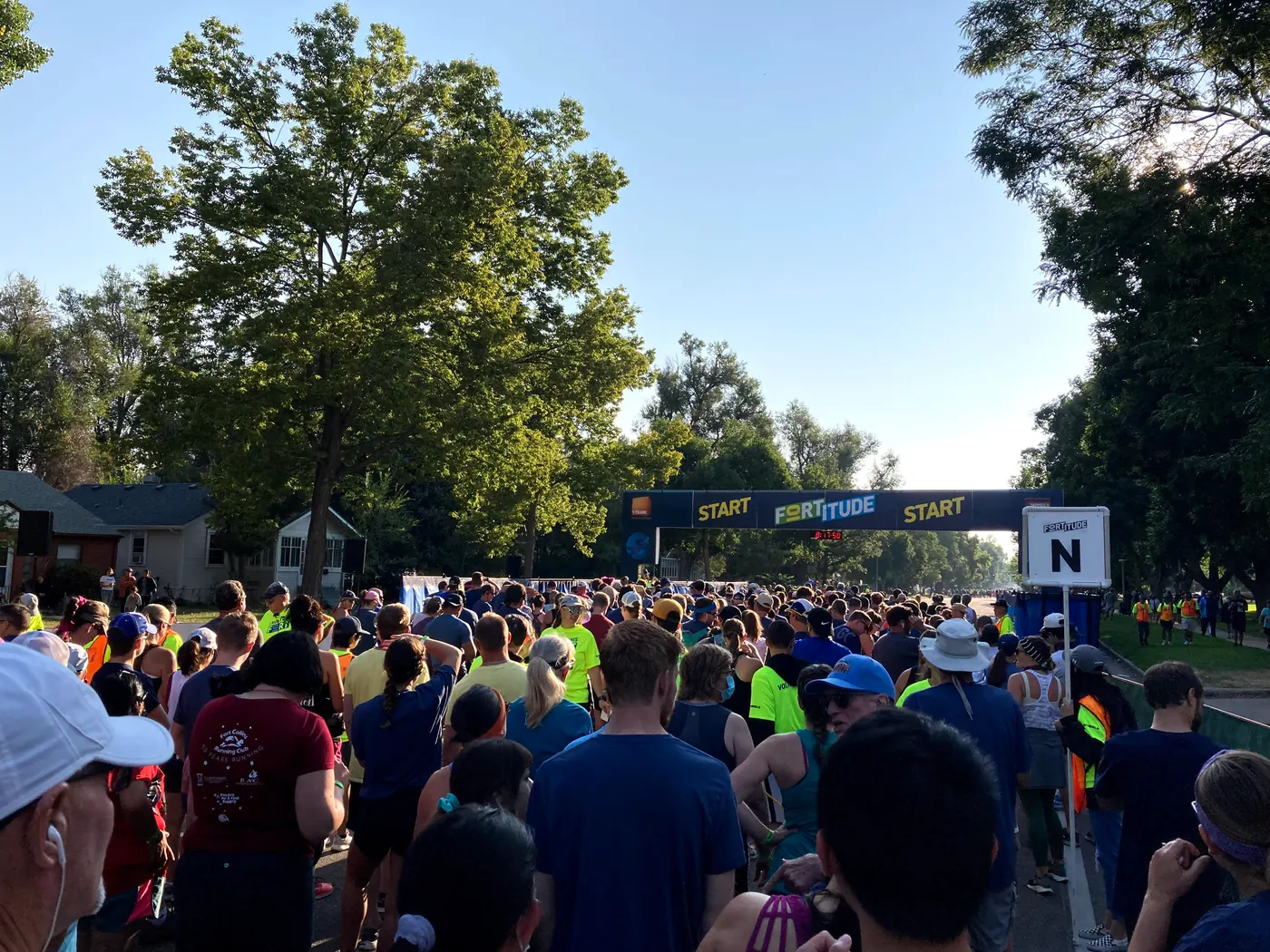
Four events shape the running year on this side of the water, and they arrive in a sequence that is almost designed as a training progression: a spring 10K, a May marathon weekend, a June mountain race, and a July ultra that takes the whole Baden Powell trail in one go.
This post is a planning tool rather than a listings page. For each event: what it actually demands, and how many weeks before it you need to have started. Dates below are the most recent running as a reference for the pattern — always confirm the current year's date with the organisers before you plan around it.
The year at a glance
| Event | Typical timing | Distance | Start training |
|---|---|---|---|
| Vancouver Sun Run | Mid-to-late April (19 April in 2026) | 10 km, road, flat | 10 to 12 weeks out — late January |
| BMO Vancouver Marathon | Early May (3 May in 2026) | Marathon, half and 8 km | 16 to 20 weeks out for the full — December or January |
| Seek the Peak | Mid-June (13 June in 2026) | 16 km, Ambleside to the top of the Grind, ~1,400 m gain | 12 weeks out — mid-March |
| Knee Knacker | Second Saturday of July (11 July in 2026) | ~48 km on the Baden Powell, Horseshoe Bay to Deep Cove | 6 months, and a qualifying history |
The pattern is worth noticing: the road events front-load the year, the mountain events own the summer, and the gap between the Sun Run in April and Seek the Peak in June is almost exactly one training block. Plenty of people use the first as a fitness check on the way to the second.
Vancouver Sun Run — the one everybody starts with
Ten kilometres, flat, road, and enormous. It is the most forgiving entry point in the local calendar and the one most first-time racers should pick.
What it demands: the ability to run 10 km continuously, which for a genuine beginner is a ten-to-twelve-week project rather than a fortnight of enthusiasm. Nothing about the course is technical and there is no elevation worth training for.
What catches people out: the crowd. Tens of thousands of runners means the first kilometre is slower than your plan and the temptation is to spend the next two making it up. That is how a comfortable 10K becomes a miserable one.
What to add to the running: two short strength sessions a week, weighted toward calves and hips. Runners get more from a small dose of lifting than almost any other group — strength training for runners covers the minimum effective version.
BMO Vancouver Marathon weekend — pick your distance honestly
Marathon, half marathon and 8 km, all on the same weekend in early May. The 8 km is a genuinely good first race, and the half is where most people who enjoyed the Sun Run end up the following year.
What it demands: for the full, a sixteen-to-twenty-week build and a tolerance for long slow Sundays. For the half, twelve weeks is realistic from a base of running three times a week.
The mistake: registering for the marathon because the half feels like admitting something. A well-run half beats a survived marathon by every measure including how much you enjoy running afterwards.
Strength during a build: keep it, reduce it. Two short sessions a week maintained through a marathon block protects tissue exactly when mileage is highest. Dropping lifting entirely during the build is the most common reason the last four weeks fall apart. Maintenance dosing applies directly.
Seek the Peak — the local one that hurts
Sixteen kilometres from the beach at Ambleside Park in West Vancouver, through North Vancouver, and then up the Grouse Grind to the top. Roughly 1,400 metres of elevation. It can be run solo or as a relay team of two to four splitting the course into legs.
What it demands: this is not a 16 km road race with a hill at the end. The flat approach lulls you and the Grind collects the debt — arriving at the base of the trail having run too fast is the defining error of the event, and the mountain is completely unforgiving about it.
What to train: sustained climbing at a repeatable effort, step-up strength endurance, and the discipline to run the flat section slower than feels right. Twelve weeks is enough from a reasonable base. We wrote a twelve-week plan for it.
The relay option is underrated. A team of four turns a brutal solo effort into a genuinely fun day, and it is a good way to get a first taste of the event before committing to the whole thing.
Knee Knacker — the one you work up to
Roughly 48 kilometres along the Baden Powell trail, traversing the North Shore mountains from Horseshoe Bay to Deep Cove, on the second Saturday of July. Both ends are near sea level; the high point is the top of Black Mountain, and the day totals something in the order of 16,000 feet of climbing and descending combined.
What it demands: a season of trail running rather than a training block, plus the specific durability to descend for hours. Entry is not simply a matter of registering — check the organisers' current requirements well ahead.
The part people undertrain: the descents. Roughly half of that vertical is downhill, and eccentric quad strength is what stands between you and a walk-in from Deep Cove. Strength training for trail runners covers why single-leg work matters more here than anywhere.
If this is a someday goal rather than a this-year goal, the sensible ladder is Seek the Peak, then a shorter local trail race, then this.
Where studio training fits
Running builds the engine. It does not build the tissue that survives the engine, and that is the whole case for putting two strength sessions a week alongside a race build.
For local events, three qualities do most of the work: single-leg strength for climbs and descents, trunk stiffness so your form holds when you are tired, and the calf and hip capacity that keeps you out of a physiotherapist's waiting room in week ten. All three are ordinary small group strength training, not a specialist program.
Timing matters more than volume. Heavy legs the day before a long run is a planning error; two short, well-placed sessions is not. If you want the sequencing built around your race date, that is a good use of a free consult — bring the date.
One last practical note: confirm the current year's date and registration window on each organiser's own site. Race dates move, entry caps fill, and a training plan built on a remembered date is a plan built on sand.
Common questions
I have never raced. Which should I do first?
The Sun Run, or the 8 km at the BMO weekend. Both are flat, well-supported and forgiving, and both give you a finish line without requiring a season of preparation.
Can I train for these entirely indoors?
For the road races, largely yes — treadmill work covers a surprising amount, especially through a wet North Shore winter. For Seek the Peak and Knee Knacker, no. Descending is a skill and a tissue adaptation, and only real trails teach it.
How do I keep training through the winter for a spring race?
Book indoor anchors the weather cannot cancel, and treat the wet months as the strength build rather than the mileage build, as in staying fit through a North Vancouver winter.
Should I do the Grouse Grind as training for Seek the Peak?
Yes, and repeatedly — but check the trail's seasonal status before planning around it, since it closes over winter; when the Grind is open explains the season.
Is a relay team a cop-out?
No. Splitting a 1,400-metre-gain course between four people produces four hard efforts rather than one, and it is the best introduction to the event there is.