
Small group strength training is barbell and dumbbell work run as a coached program rather than a workout: the same core lifts come back week after week, the weight on your bar is chosen for you, and a coach who knows what you lifted last time decides when it goes up. At Coresa it now happens inside personal training, 1-on-1 or semi-private; small group training in larger groups is no longer offered.
That ceiling is the whole design. Strength work is the part of training where load, position and timing all have to be right, and it is the part that quietly stops progressing the moment nobody is watching. Eight is the number at which one coach can still watch the sets that matter.
What makes it strength training rather than a hard workout
A hard workout leaves you tired. A strength program leaves you measurably stronger, and the difference is repetition with intent. In a strength session the movements are not a surprise: you squat, hinge, push, pull and carry, and you meet those same patterns again next week with slightly more asked of you.
Randomness feels productive because it is always novel and always tiring. It is also why so many people train for a year and lift the same weights in month twelve that they lifted in month two. Novelty is a poor substitute for a plan; sweat is not a progress metric.
Three things separate the two in practice, and you can audit any studio in town against them:
- The lifts repeat. If you cannot predict roughly what patterns are coming, nothing is being progressed.
- Somebody writes the numbers down. Loads that live only in your memory drift downward on tired days and never recover.
- The load is prescribed, not chosen off a rack by feel. Picking your own weight tends to mean picking yesterday's weight.
Coresa's small group sessions are prepared before you walk in: your coach sets up your station and your starting loads rather than handing the room one shared workout. That preparation is what makes a group session a strength session.
The five patterns the program is built around
Almost all useful strength work reduces to five movement patterns. Train all five, load them properly, and you cover the strength a body needs for hills, luggage, kids, ski season and old age.
| Pattern | What it looks like | What it buys you |
|---|---|---|
| Squat | Goblet, front and back squats; split squats and step-ups | Legs that hold up on stairs, hills and the Grouse Grind |
| Hinge | Deadlift variations, Romanian deadlifts, hip thrusts | A back that tolerates lifting things off the ground |
| Push | Dumbbell and barbell presses, incline work, push-ups | Shoulders that stay strong and stable overhead |
| Pull | Rows, pulldowns, chin-up progressions | The counterweight to a desk, and the reason your posture holds |
| Carry | Farmer carries, suitcase carries, loaded marches | Grip, trunk stiffness and the most transferable strength there is |
You will not meet all five every session. They are distributed across the week so each pattern gets trained hard, then given time to recover, which is the only way loads keep climbing. If the vocabulary is new, the beginner's guide to strength training walks through each pattern in detail.
The exercises we coach here
Every movement in the program has its own coaching page in our exercise library: what it trains, the setup, the cues we actually use on the floor, the faults we correct most, and what it progresses to. A few of the staples:
The full library lives at the exercise hub, organized by movement pattern, with workouts you can run on your own between coached sessions.
How your load gets chosen (and when it goes up)
Your first session is where the numbers start. Your coach watches you move through the patterns at a light weight, then sets starting loads that let you complete every rep with control and a little left in reserve. Nobody tests a maximum on day one, and nobody should.
From there the load moves when the evidence says it should. The signal coaches look for is a set that finishes strong: the last rep looks like the first, your speed has not collapsed, and you could plausibly have done two more. When that happens across a session, the weight goes up next time. When it does not, the weight stays and the reps or the control improve instead.
This is progressive overload, and weight is only its most obvious lever. Adding a rep, slowing the lowering phase, shortening the rest, or holding a cleaner position at the bottom of a squat are all genuine progressions, and they are the ones that keep working after the easy early gains are gone.
The practical benefit of a coached group is that somebody else is tracking this. You are not standing in front of a rack trying to remember what you did eleven days ago.
What a block of training actually looks like
Strength arrives in blocks, not in single sessions. A block runs long enough for the same lifts to be repeated several times, which is what lets the load climb, and then the movements change enough to keep the stimulus honest.
Inside a block the arc is predictable: the first week or two feel technical and slightly awkward as your body relearns positions, the middle weeks are where the numbers move fastest, and the last week is where you notice that a weight which felt heavy at the start is now a warm-up.
Your first month is mostly about wiring rather than tissue. Early strength gains come from your nervous system getting better at recruiting the muscle you already own, which is why lifts often climb quickly at the start and then settle into a slower, more durable rhythm. How long it takes to get stronger covers that timeline honestly.
None of this requires you to understand programming. It requires you to show up on a schedule you can actually hold, which is the one variable a studio cannot do for you.
The equipment you will be using
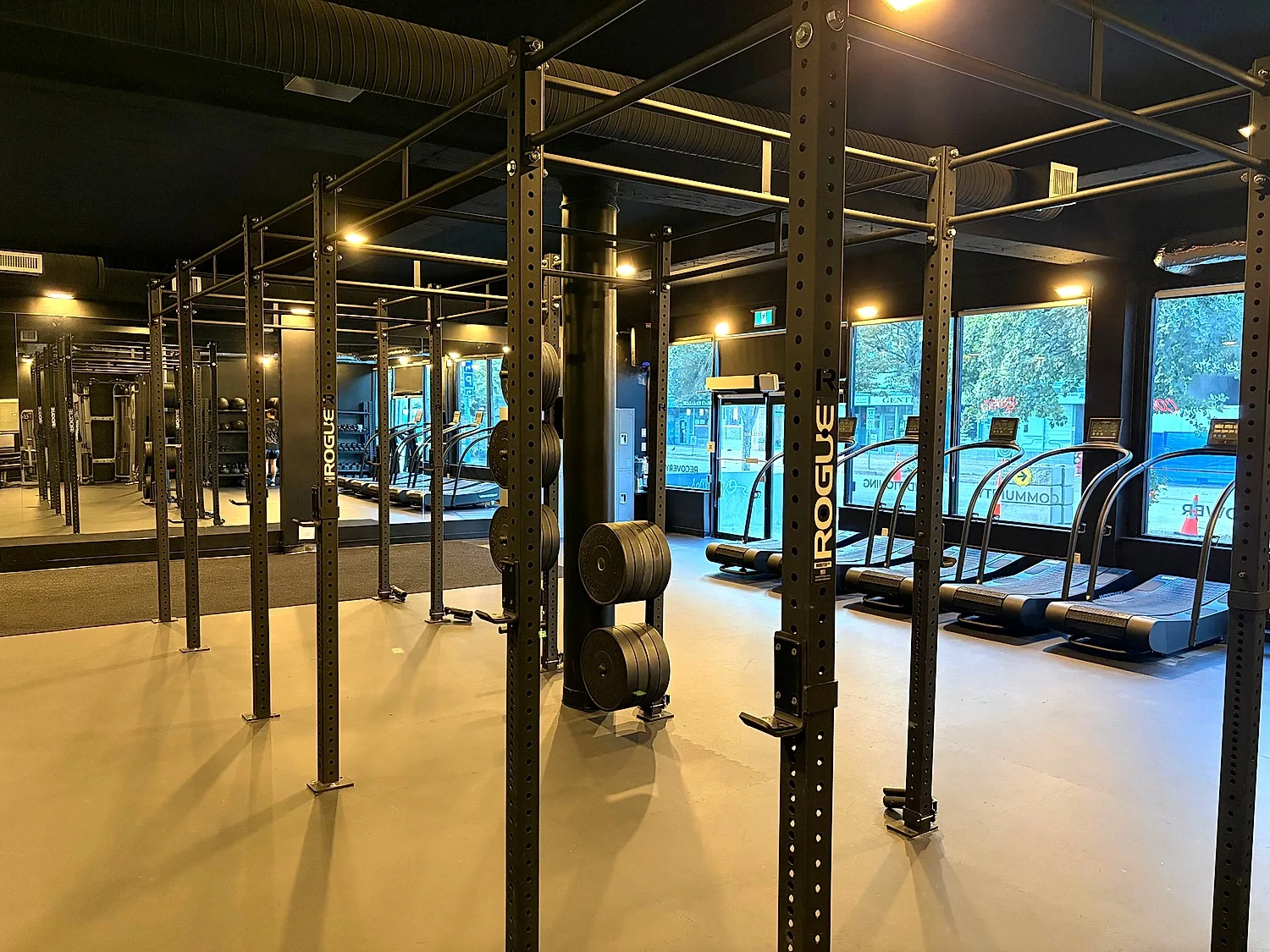
The strength side of the floor is deliberately conventional. There is a rig with squat racks along the street-facing windows, barbells and plates, a full run of dumbbells, medicine balls, and cable machines and functional trainers for the accessory work that keeps shoulders and hips healthy.
Nothing here is exotic, and that is the point: the tools that build strength have not changed in decades, and a well-coached barbell will outperform any machine that promises to do the thinking for you. If you would rather see the floor before deciding, the studio photo tour shows the rig, the racks and the rest of the room.
For where machines genuinely earn their place alongside free weights, we work through the trade-off in free weights versus machines.
Strength here, or conditioning?
Pick strength if the outcome you want is a number that moves: a heavier deadlift, a first chin-up, legs that stop complaining on the Grind. Conditioning still has a place in the week, and inside a coached program it is dosed rather than guessed: treadmill intervals, carries and medicine-ball work sit around the lifts, not instead of them. Strength and cardio on the same day covers how the two are sequenced.
Most people who train here end up doing both, and there is no interference problem worth worrying about at normal training volumes. If you want the two formats compared properly before you choose, group training in North Vancouver lays them side by side.
Training in Lower Lonsdale
The studio is at 142B 3rd Street West, two blocks up the slope from the water and a few doors west of Lonsdale Avenue. It is roughly a six to eight minute walk uphill from the Lonsdale Quay SeaBus terminal, which makes it easy to fit a session around a cross-harbour commute in either direction.
Doors are open from 6:00 am to 8:00 pm every day of the week, weekends included, so a strength habit does not have to survive on one narrow window. Street parking around 3rd Street West is the usual Lower Lonsdale mix of metered and time-limited blocks; it is easy at dawn and tighter in the evening, and the signage on your block is the only rule that counts.
Everything else about getting here, including transit and what to bring, is on the Our Space page.
Common questions
Is this a strength class?
Not in the usual sense. A class gives the room one workout; this gives you a program, your own prescribed loads, and a coach tracking your progress between sessions. The group is capped at eight so that is actually possible.
Do I need to know how to lift before I start?
No. Technique is taught before load is added, and every pattern has a version that fits where you are today. Coaching exists for exactly this point in the process, not for people who have already figured it out.
Will lifting like this make me bulky?
No. Muscle grows slowly and only under sustained, deliberate effort with the food to match. What most people notice first is that they are stronger and their clothes fit differently, not that they are bigger. The long version is in will lifting make me bulky.
How soon will my lifts actually go up?
Most people feel their lifts climbing within two to four weeks, because the early gains are neural rather than muscular. Tissue-driven strength builds over the following months. The honest timeline has the detail.
What if I have an old injury or a cranky back?
Tell your coach on the consult and again on your first session. Most histories are worked around rather than trained through, and patterns get swapped rather than skipped. Anything that is currently painful should be assessed by a physiotherapist first, which we cover in strength training with a bad back.
How many strength sessions a week do I need?
Two is the floor that reliably builds rather than maintains, and three to four is where progress comes fastest without taking over your calendar. How many days a week to strength train works through how to pick your number.