Safe squatting and hinging rest on three things you can hold in your head: brace your trunk before anything bends, know which of the two patterns you're performing — knees travelling forward or hips travelling back — and only count depth you can control. Everything else about these lifts is refinement layered onto those basics.
Words can carry you a long way here, but they have a ceiling. This page gets you oriented; a coach's eyes finish the job.
Squat or hinge: decide which movement you're in
A squat lowers you between your feet: knees and hips bend together, knees travel forward, and your torso stays relatively tall — like sinking straight down onto a low stool directly beneath you. Goblet squats, air squats, and standing up from the couch all live in this pattern.
A hinge sends your hips backward while your shins stay nearly vertical and your torso tips forward as one unit — reaching your hips toward a wall behind you. Deadlifts, kettlebell swings, and picking a box off the floor are all hinges.
Most shaky reps are a blend that never chose: a squat that collapses into a bent-over hinge halfway down, or a deadlift that sinks into a squat at the floor. Pick the pattern before the rep begins, and the rep improves on its own.
Brace before you bend
Bracing means creating stiffness through your midsection before the load asks for it. Take a breath into your belly and sides, then lightly tense your trunk as though someone were about to lean on you — ribs stacked over pelvis, spine in its neutral-ish zone. That zone is a comfortable range, not a rigid arrow-straight line; the goal is a shape you choose and keep, not a pose.
The brace comes before the descent and holds through the rep. On anything heavy, reset it between reps — the exhale-and-rebrace rhythm is part of the lift, not an interruption to it.
Depth honesty
Count only the range you can own: heels down, trunk shape held, the descent under control the entire way. For squats, honest depth is wherever those conditions still hold today — for plenty of people that's above parallel at first, and it deepens with practice. For hinges, the range ends where your lower back begins rounding to reach further; the weight comes up to you on blocks if needed, rather than your spine going down to it.
A shallower rep you control completely builds more than a deeper one you fall into. Range is earned, and it expands steadily once the only reps you count are clean ones.
Then get coached eyes on you
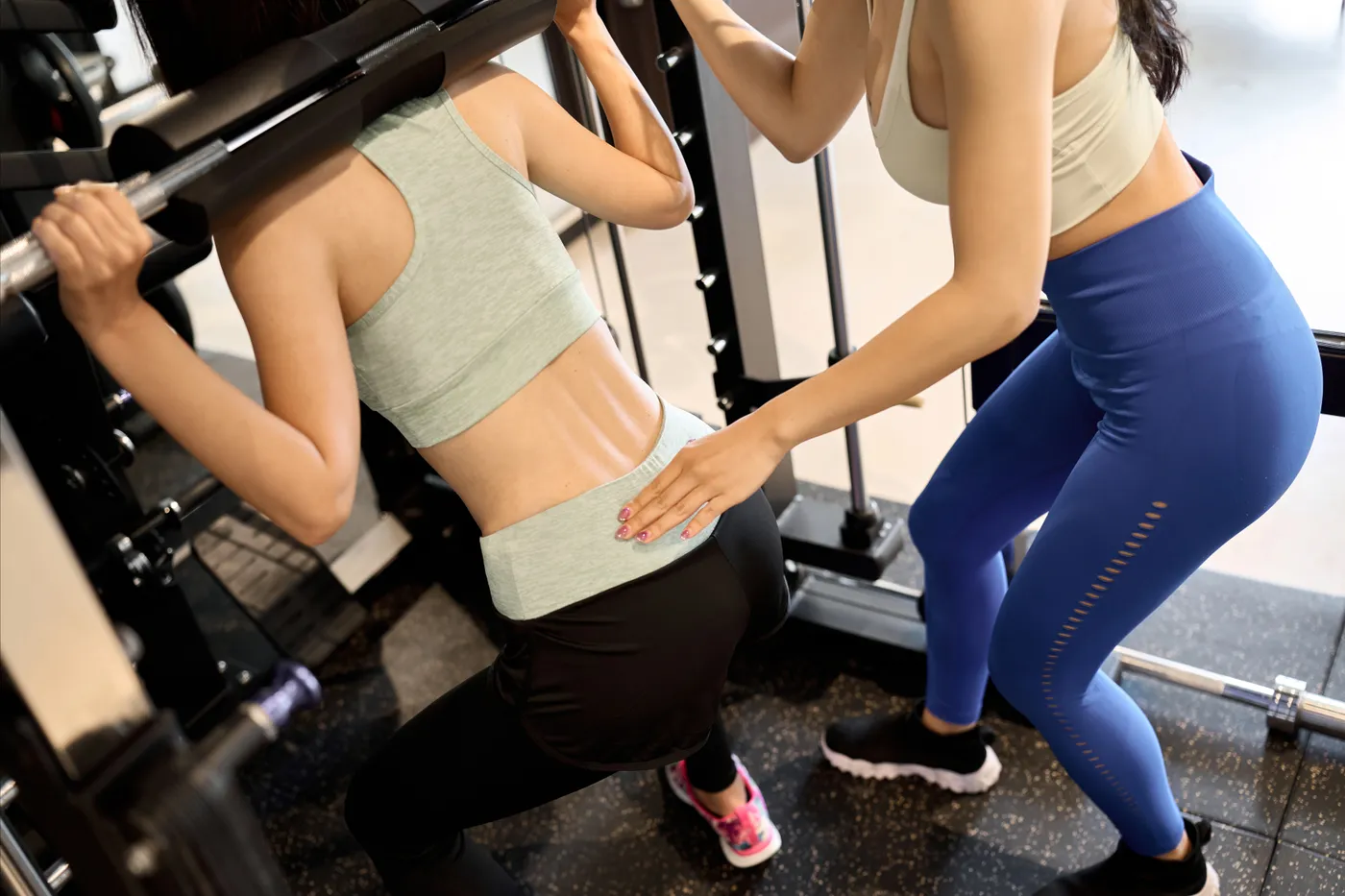
Here's the honest ceiling of any article about lifting technique: you cannot watch yourself lift. Filming a side view and comparing it against the descriptions above genuinely helps — but a coach watching live catches the drift you can't feel and corrects it while the rep is still happening, which shortens the learning curve enormously.
These two patterns anchor the programming in coached strength classes, where correction is built into every station, and small group personal training puts even more eyes per rep on you while the patterns are still forming. If you'd like to hear how that coaching works before booking anything, a free 15-minute consult call is the zero-pressure way to find out.
Common questions
Should my knees stay behind my toes when I squat?
No — knees travelling past the toes is normal and, for many body proportions, necessary for a full squat. The old cue survives because it accidentally teaches hip loading, but taken literally it mostly just produces shorter squats.
Which should I learn first, the squat or the hinge?
Whichever comes easier, practised until it's boring — owning one sharpens the other by contrast. Many people find the squat more intuitive and the hinge more coachable, often with a dowel held along the spine as feedback.
Do I need a barbell for either pattern?
Not for a long time. Bodyweight, a dumbbell held at your chest, or a kettlebell covers both patterns through months of progress. The barbell is one implement among several — not the entry requirement.
Is it a problem if my back rounds a little?
Spines aren't made of glass, and small changes in shape under light load are part of normal human movement. The working rule: keep loads at a level where you can hold the shape you chose, and treat repeatedly losing it as a signal to lighten, rebuild, and get a coach's input.