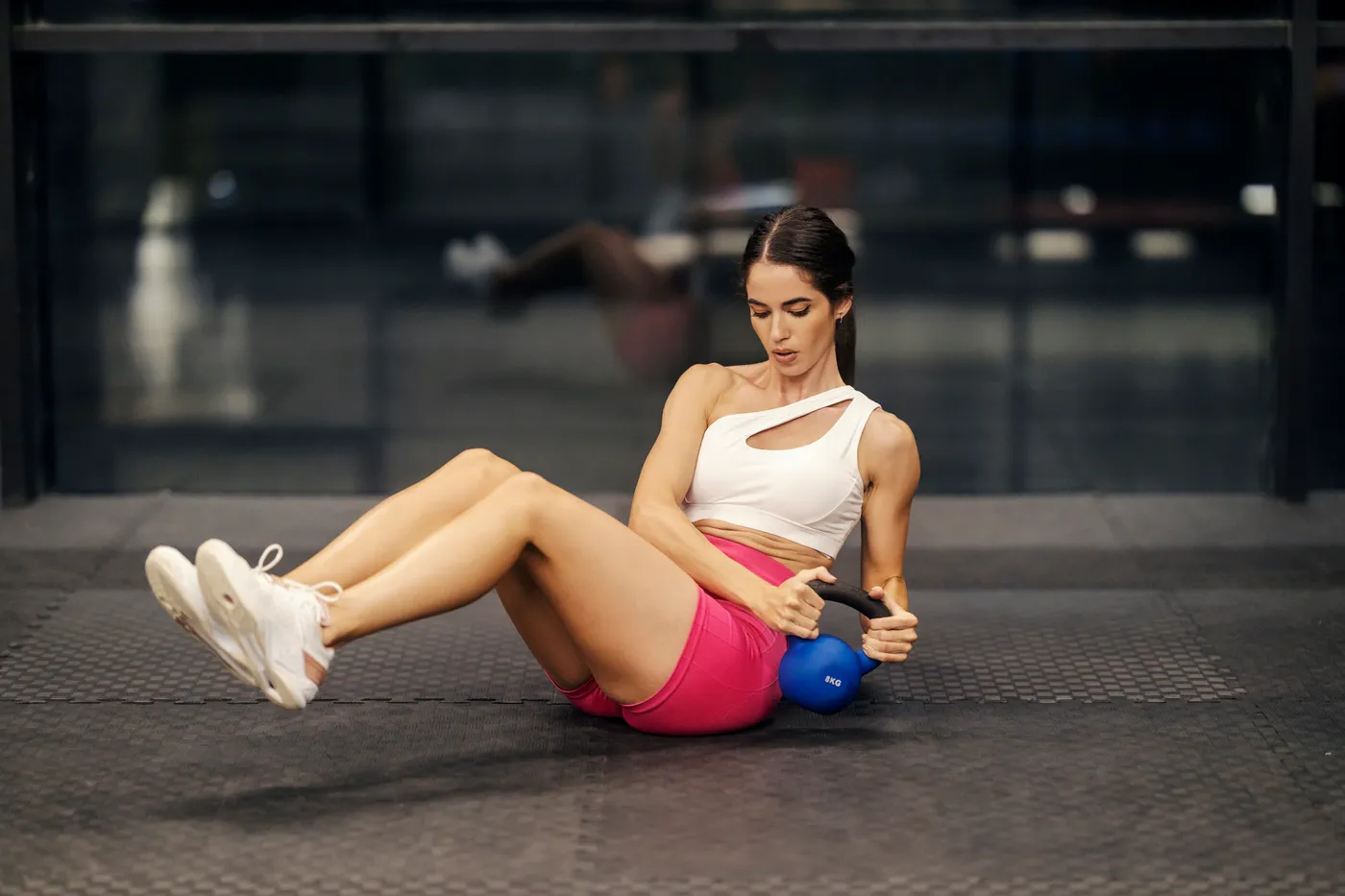
Give compound movements — multi-joint lifts like squats, rows, presses, and hinges — the first and largest share of your effort, and use isolation work as a targeted supplement rather than the main course. Compounds train more muscle, more skill, and more real-world capability per minute, which matters enormously when your session is 45 minutes rather than two hours.
The distinction in one glance
A compound movement works multiple joints and recruits whole chains of muscle in a single rep — a goblet squat involves legs, glutes, trunk, upper back, and grip all at once. An isolation movement deliberately narrows the job to one joint and essentially one muscle: a biceps curl, a calf raise, a leg extension. Neither category is good or bad; they simply have different reach.
A rough field test: if you can name the single muscle an exercise trains, it's isolation. If naming just one feels impossible, you're looking at a compound.
Why compounds win the biggest slice
- Time return. Four or five compound movements can touch essentially every muscle you own. Covering the same ground with isolation exercises would take a dozen movements and twice the clock.
- Skill that transfers. Compounds rehearse how the body actually operates — joints coordinating under load — which shows up hiking the Grouse Grind, shovelling the driveway, and wrangling luggage.
- A larger training signal. More tissue working per set means more total stimulus for strength from the same number of sets.
The one thing compounds ask in return is attention: multi-joint lifts carry technique worth learning properly, which is why they reward coaching early — and why they're where a coach's corrections pay off most.
The jobs isolation does better
Isolation earns its minutes whenever precision beats breadth:
- Bringing up a specific area the compounds keep under-serving
- Working around a cranky region — training a limb hard without loading the whole system
- Adding useful volume late in a session, when fatigue makes complex lifts sloppy but a curl or raise stays crisp
- Plain enjoyment — arms and shoulders respond well to direct work, and liking your training is adherence fuel
Budgeting a 45-minute session
| Session slice | What goes there | Why then |
|---|---|---|
| First ~5 minutes | Warm-up | Prepares the big lifts that follow |
| Middle ~30 minutes | Three or four compound movements | Your freshest attention goes to the highest-return work |
| Final ~10 minutes | Isolation and loaded carries | Their quality survives fatigue; complex lifts' quality wouldn't |
That's close to how a coached circuit session arranges its stations: big patterns anchor the hour while smaller movements fill the seams, so the budget gets spent well without you having to plan it.
Which implements to use for each piece is a separate call — free weights vs machines takes that question on directly.
Common questions
Should a beginner skip isolation entirely?
You could for months and lose very little — compounds cover a beginner's needs almost completely. Add isolation once you have a concrete reason: a lagging area, a preference, or spare minutes at the end of a session.
Is a lunge compound or isolation?
Compound — hips, knees, and ankles all contribute, plus a real balance demand. Single-leg doesn't mean single-muscle.
Why do bodybuilding programs use so much isolation?
Because their goal is targeted size in every visible muscle, judged aesthetically — precision volume is literally the job. If your goal is capability per hour of training, the math tilts back toward compounds.
Can core training be compound?
Yes. Loaded carries, and simply holding a braced trunk under squats and presses, train the core in its actual job of resisting and transferring force. Direct core moves still help — they're just not the only source.