
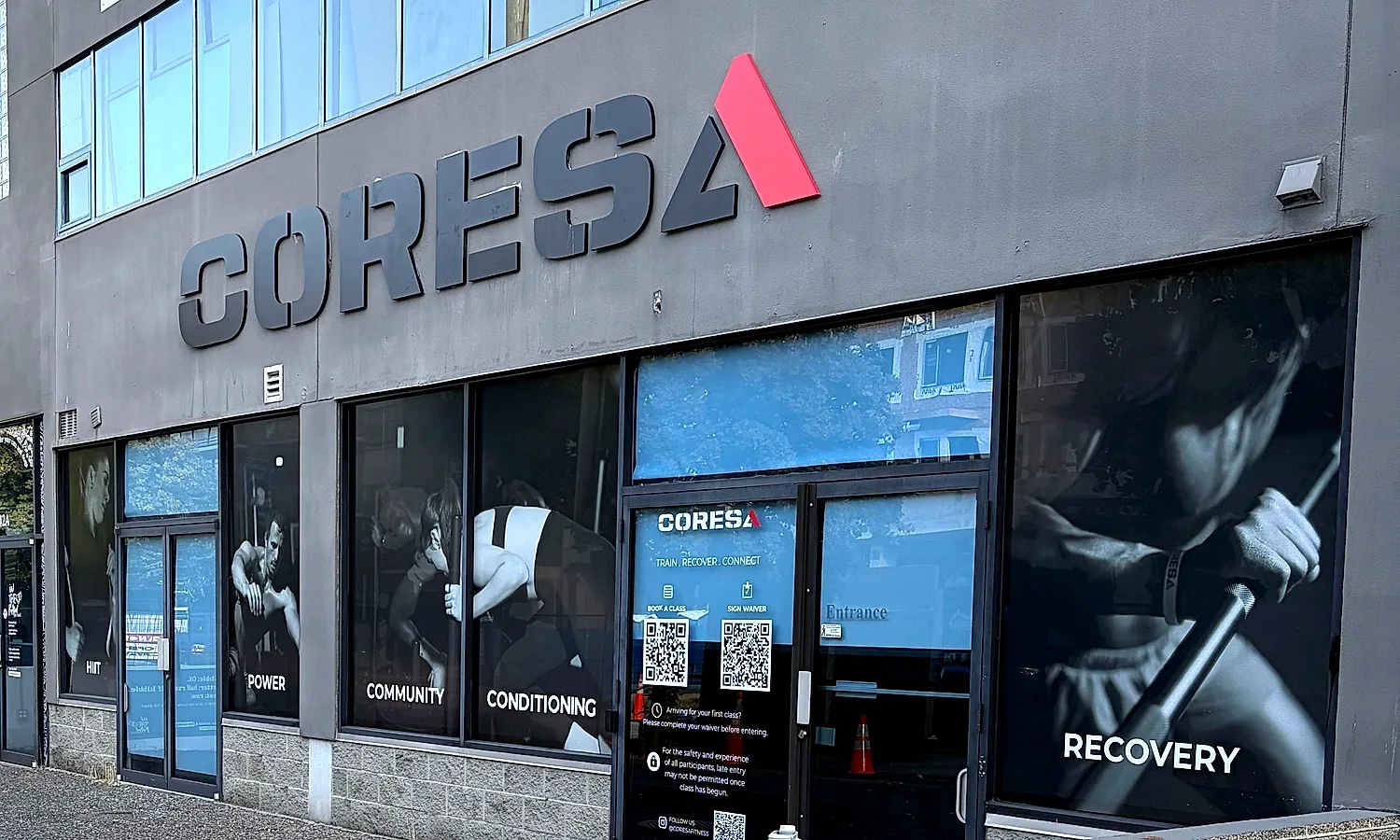
Update, October 2026: Coresa now offers personal training only, 1-on-1 or semi-private. Small group training is no longer on the menu, so read the routing below with that in mind; the three questions have not changed.
On a free consult at Coresa we ask three questions: what are you training for, what does your body currently object to, and which hours can you actually defend every week. The answers route nearly everyone to 1-on-1 personal training or semi-private personal training, and occasionally to neither yet.
This post is the routing logic, written down, including the cases where the honest answer is the less expensive program or no program yet. The consult itself is a fifteen-minute phone call, no workout and no card. This is about the decision made in it.
Question one: what are you training for?
The first question sorts by specificity. A general goal, which is most goals, routes to the group: stronger, leaner, fitter for the mountains, less stiff after a desk day. The group delivers exactly what a general goal needs, a progressing program, prescribed loads, a record and company, at a cost that makes two to four sessions a week sustainable.
A specific goal on a fixed date routes differently. A race in twelve weeks, a fitness test for a job, a first chin-up by a birthday, a return to sport after surgery: these need a program written around one thing, revised often, by a coach who can spend a whole session on it. That is 1-on-1, at least for the block that gets you there.
The trap is assuming ambitious means specific. Wanting to deadlift double your bodyweight is ambitious and general, and the group handles it well. Wanting to deadlift a number on a platform on a date is specific.
Question two: what does your body currently object to?
The second question sorts by how much watching the first weeks need. Nothing objecting, or an old history that has been rehabbed and is now just a note on the card: the group, with the swaps written in advance. Something currently painful that no clinician has looked at: neither program yet. We will say so plainly and point you to a physiotherapist first; personal trainer or physiotherapist explains where that line sits.
The middle case is the interesting one: cleared by a physiotherapist, told to load it, and nervous. Here the routing depends on how much of the program the objection touches. A shoulder that rules out overhead work touches a few lifts, and the group absorbs it with swaps. A back that changes every hinge, squat and carry touches everything, and a short 1-on-1 block to rebuild the patterns is faster and safer, with the group waiting afterwards. When to move from 1-on-1 to small group describes that handover.
Question three: which hours can you defend?
The third question decides more placements than the first two combined, and people are often surprised by it. Small group sessions run at set times on the live schedule; 1-on-1 runs by appointment around your week. If your defensible hours are the same two evenings every week and the group has sessions then, the group is the answer. If your week changes every week, the schedule is the problem rather than the program, and 1-on-1 may be the only format that survives it.
This is also where the smaller-group question gets answered. Semi-private, the industry's name for two to five people with one coach, is not a separate product here; it is the small end of the group. Some sessions run well under eight. If one of those matches your hours and your goal, you may find yourself in a very small group without asking for one. If not, we will say so rather than promise one. The semi-private page covers what that trade looks like.
How the answers combine: five people, five placements
These are composites, not members, but every line is a placement we make regularly.
| Who walked in | What the three answers were | Where we sent them |
|---|---|---|
| A desk worker who wants to be stronger and stop dreading stairs | General goal; nothing objecting; two fixed evenings a week | Small group. The less expensive option was the right one, and we said so. |
| A trail runner with a race date twelve weeks out | Specific goal on a date; a hamstring that is fine but watched; irregular hours | 1-on-1 for the block, then the group after the race. |
| A couple, one chasing a heavier deadlift, one rebuilding a knee after physio | Two different goals; one cleared objection; the same two mornings | Small group, same session, separate programs. The slot they could make happened to run quiet. |
| Someone who asked for private coaching because they felt self-conscious | General goal; nothing objecting; flexible hours | Small group. Feeling self-conscious is not a reason to pay for 1-on-1, and the room is kinder than they expected. |
| Someone with a back that hurts today and no diagnosis | General goal; an unassessed objection; any hours | A physiotherapist first. We would rather lose the sale than load a back nobody has looked at. |
Notice that three of the five went to the less expensive program. That is not generosity; it is the routing working. Sending someone to 1-on-1 who would thrive in the group costs them money and costs us a member who quits in month three.
What you leave with, and what you can change
You leave the consult with one recommendation, said out loud, and the reason for it. If you disagree, argue; the questions are a framework, not a verdict, and you know your week better than we do. Sessions are booked individually on the live schedule or the Coresa app, so a placement is a starting point. People move from 1-on-1 to the group when the rebuild is done and, less often, from the group to 1-on-1 when a specific goal appears. The record travels with you either way.
How small group memberships and 1-on-1 packages are structured is explained on the consult, in plain terms.
Common questions
What if I already know which program I want?
Tell us, and we will still ask the three questions, because occasionally the answer is not the one you came in with. If your choice and the routing agree, which they usually do, you leave with the booking. If they disagree, you leave with the reason, and the decision is yours.
Will you tell me if neither program fits?
Yes. The clearest case is pain that has not been assessed, which goes to a physiotherapist before it comes to us. The other is somebody whose goal is simply to move and feel good on a small budget, for whom a rec centre class or a walking habit up the Lonsdale hill is a fair answer, and we will say so.
Can I be placed in a smaller group straight away?
Only if the schedule already has a session that runs small in your hours. We do not create groups of a fixed size on request. What we do is look at the timetable with you and tell you honestly which sessions are quiet.
Is the placement the same as the general comparison on the site?
Small group training versus 1-on-1 is the general case: attention, cost and accountability weighed for a reader we have never met. The consult is the specific case, with your hours and your history on the call. They usually agree; when they do not, the consult wins. What happens at the free consult covers the visit itself.