
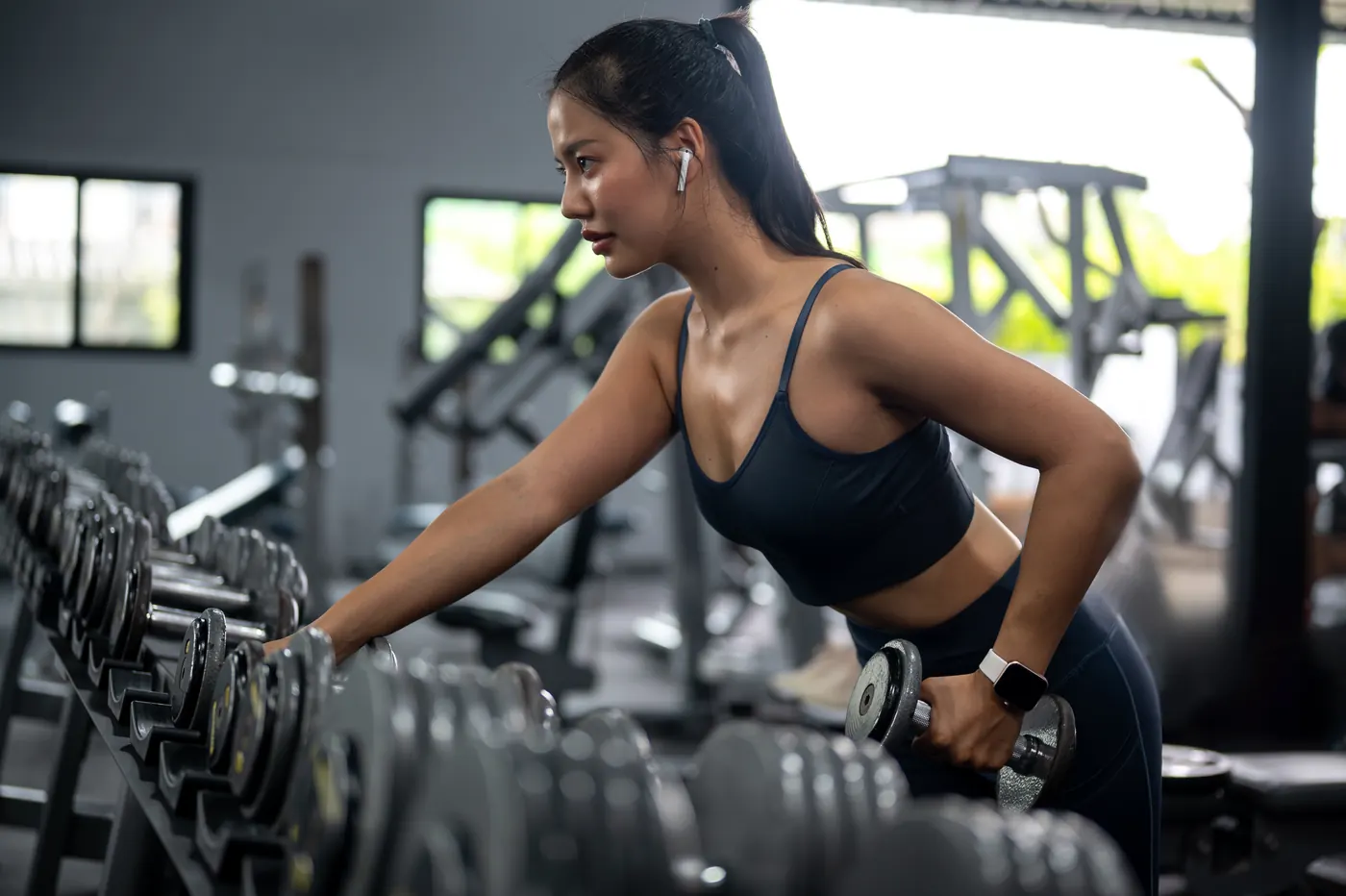
Yes — for most of the upper body, close to indefinitely, and for legs, longer than the barbell industry implies. Dumbbells load every pattern that matters, they teach honest stabilization, and a full rack outlasts most people's first two years of pressing and rowing progress. Where they eventually run out is the lower body: squats and hinges outgrow holdable weights, because legs get strong faster than grips and setups can keep feeding them.
So the honest frame is a sequence, not a limitation: dumbbells first and fully, the barbell when the biggest patterns earn it.
Where dumbbells are genuinely the better tool
Pressing: independent arms expose and fix imbalances, and rotatable grips let shoulders choose their happy angle — much of why dumbbell pressing precedes barbell pressing in most coached progressions. Rowing: the single-arm row is arguably the best first pull in existence. And the whole single-leg universe — split squats, step-up patterns, single-leg RDLs — where a moderate dumbbell load produces leg work that humbles barbell lifters, because one leg is doing what two shared.
Milking the rack before declaring it finished
When the next dumbbell up feels impossible and the current one boring, the levers multiply demand without adding kilograms: slower descents per tempo work, added reps and sets, shorter rests, pauses at the hard position, and above all the two-to-one trick — converting bilateral movements to single-limb, which effectively doubles the load per limb from the same rack. A goblet squat that plateaued becomes a rear-leg-supported split squat and buys months. These are the same overload levers every program runs; dumbbells just demand them sooner and teach them better.
When the barbell earns its entrance
The tell is specific: your squat and hinge patterns are clean, your single-leg work is strong, and the limiting factor on leg day is literally holding the weight — grip, rack position, getting the dumbbell into place — rather than legs. That is the graduation moment, and it is a happy one: the barbell exists precisely to let legs and backs train past what hands can hold. In a coached room the transition is a non-event — the patterns transfer directly, the coach sets the bar loads, and dumbbells keep their permanent seats in the program for everything they still do best.
Common questions
Can I build muscle with only dumbbells at home?
For quite a while, if the effort is honest and the adjustable range is decent — the growth inputs are effort and volume, which dumbbells deliver fine. The stall arrives via the same leg-loading ceiling, on hypertrophy's schedule.
What dumbbell weights should a home rack cover?
Adjustable pairs reaching at least the mid-range of your goals beat many fixed pairs — the single-leg trick extends whatever ceiling you buy. Specific numbers depend on you; a coach can bracket them in one session.
Are kettlebells the same answer?
Broadly overlapping with a different accent — swings and offset carries especially. The equipment matters less than the progression discipline applied to it.