
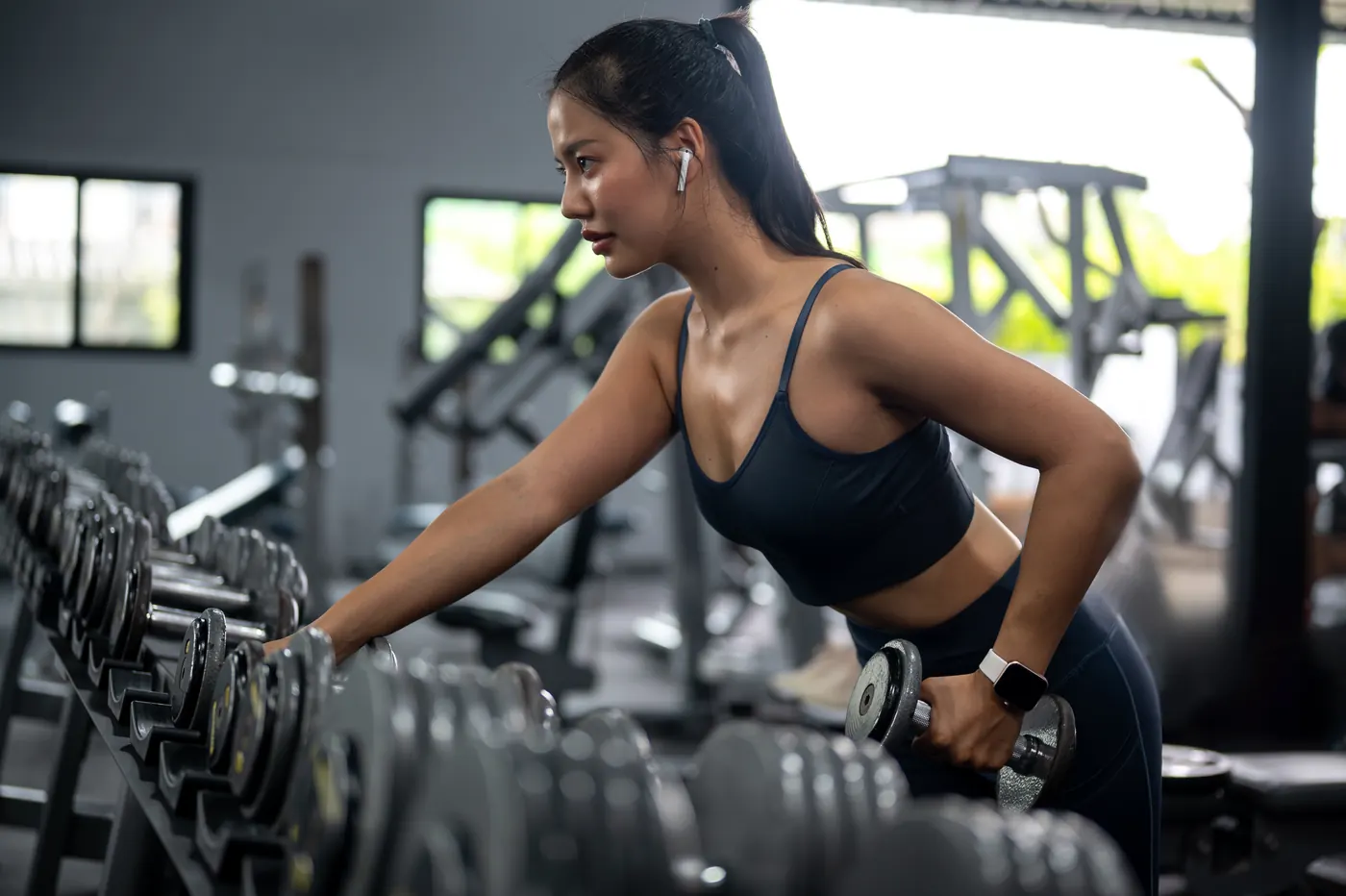
Pick a dumbbell weight by testing it, not by guessing it: choose a pair you are fairly sure is too light, do the planned reps, count how many more you could have done with the same form, and adjust the next set from that count. Two or three left in the tank means you found it. Five or more means go up one size. None left means come down one. The first set of every homework session is the measuring instrument.
That is the whole method. The rest is how to run it well without a coach: where to start for each kind of movement, the rule for going up, and the two mistakes that freeze progress for months.
The test-set method, step by step
On a homework day you become the coach. This procedure replaces the coach's eye.
- Start one size lighter than your instinct, which is calibrated to the last time you felt strong, probably with someone counting for you.
- Do the prescribed reps at a steady tempo: two seconds down, a pause if the program asks for one, a controlled push or pull back up. No bouncing, because bounce hides the truth.
- At the last rep, ask one honest question: how many more could I have done exactly like that? Write the number down, even if it is a guess.
- Adjust the second set by the answer. Five or more in reserve: go up a size. Two or three: stay. Zero or one, or a last rep that changed shape: go down a size.
- Record the weight you finished on. That is next week's starting weight, and next week's first set is the next test.
The count you are making is what coaches call reps in reserve. Two in reserve is the default for almost every homework set: heavy enough to drive change, light enough that form survives without anyone watching.
Starting points by movement family
No chart can give you a starting kilogram; bodies, training histories and racks all differ. What holds everywhere is the order, and knowing it stops you reaching for the same pair for everything.
| Movement family | Where to start | How the right weight feels |
|---|---|---|
| Squats and hinges (goblet squat, dumbbell RDL) | The heaviest family. A pair you can hold comfortably; the legs usually outgrow the grip. | Legs working hard by the last third of the set, grip and trunk steady. |
| Rows and presses (single-arm row, shoulder press, floor press) | A middle weight. Rows tolerate more than presses for most people. | The last two reps slow noticeably; the elbow path does not change. |
| Carries | Heavier than you expect. A pair adding up to roughly half your body weight is a common early target, reached over weeks. | Posture stays tall for the whole distance; grip ends the set. |
| Curls, lateral raises, reverse flies | The lightest family, often the two lightest pairs in the rack. | A burn arrives well before the set ends; no shrug, no swing. |
If you own one pair of dumbbells, the weight that suits a goblet squat will be far too heavy for a lateral raise. Work the squat with it, adjust reps and tempo for the rest, and treat the mismatch as a reason to buy a second pair, not a reason to skip the small movements.
When to go up, and by how much
Go up one size when you finish every prescribed set with three or more reps in reserve, two sessions in a row. One session can be a good day. Two is a pattern.
The move is one rack position, not two. Rack jumps look small on the label and feel large in the hand, and a two-size jump usually costs reps, form and confidence at once. If one size up feels impossible and the current pair feels easy, add a rep to each set, slow the lowering to three seconds, or add a pause at the hardest point. Those are loads in disguise, and they bridge the gap until the next pair fits.
A single-arm dumbbell row is the clearest example. The weaker side decides the weight for both sides; when the weaker side earns the next pair, both sides move.
The two mistakes that stall homework days
Racking the same pair for months
This is the common one. The weight that was honest in week two becomes a habit by week ten, the test set stops being a test, and the session becomes a rehearsal of something the body already knows. If your log shows the same numbers for four weeks and nothing hurts, the answer is in the log.
Jumping two sizes because the first felt easy
This is the enthusiastic one. An easy first set is information about one set. Two sizes up turns a press into a grind and a row into a swing, and often ends with the pair back on the rack after three reps. One size, every time.
What to bring back to your coach
Homework days feed the coached ones. A written line per exercise, with weight, reps and reserve count, lets a coach see in seconds whether your home loads track the loads they set in the room. At Coresa, personal training runs on individual loads that the coach records; keep your home numbers in the same notebook. The beginner full-body dumbbell workout is a homework session already written for this method, and whether dumbbells alone can carry your strength answers the longer-term question.
Common questions
Should both arms use the same dumbbell weight?
Yes, and the weaker side chooses it. Most people have one side that presses or rows a little less well; loading it heavier to match the strong side teaches the strong side to cheat. Match to the weaker arm and the gap closes on its own over a few months.
Is it better to guess too light or too heavy on a homework day?
Too light. A light first set costs thirty seconds and gives a clean test; a heavy first set costs form, sometimes the whole exercise, and teaches nothing usable. The adjustment rule makes a light guess correct itself by set two.
Do I need a different weight for every exercise in the session?
Nearly always. One pair for everything is either too heavy for the small movements or too light for the big ones. Two or three pairs cover most home programs; at the studio the full rack is there.
What if I cannot tell how many reps I had left?
Film the last two reps of a set and watch the speed. A rep clearly slower than the first is close to the edge; a rep that looks identical was not. The count becomes accurate within a few weeks, and a coach can check your estimate against their own at your next session.