
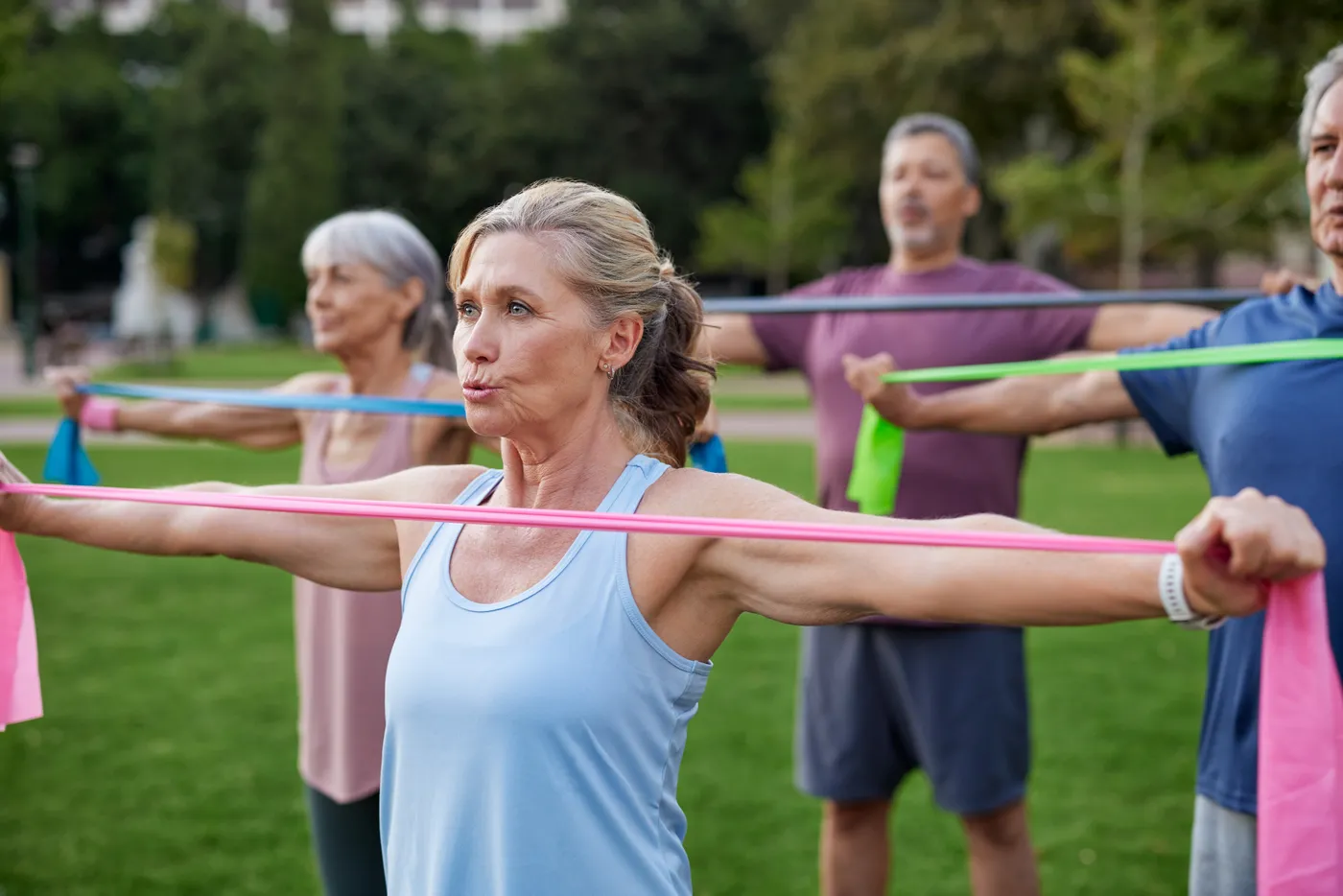
Strength training with osteoarthritis in the knees or hips is not just allowed; it is one of the first things guidelines recommend, ahead of injections and long before surgery. Stronger muscles around an arthritic joint absorb load the cartilage would otherwise take, and regularly loaded joints tend to hurt less and move better than rested ones. The rule that makes it work is hurt versus harm: some discomfort during and after is acceptable; pain that ramps and stays, swells or wakes you is not. Your physician or physiotherapist confirms the diagnosis and sets the limits; a coach trains inside them.
This page is about the arthritic joint you still have, not the one that has been replaced (that is after a knee or hip replacement) and not about bone density (that is osteoporosis, a different condition with a similar name). Osteoarthritis is cartilage and the joint around it; the fix is muscle.
Why muscle is the first prescription, not the last resort
Every major osteoarthritis guideline we know of puts exercise, including strengthening, in the core first-line treatment alongside education and, where relevant, weight management. The reasoning is mechanical and biological at once. Mechanically, a strong quadriceps and a strong set of hip muscles share the load of standing, walking and stairs with the joint surface. Biologically, cartilage has no blood supply and is nourished by being loaded and unloaded; a joint protected from all load does not heal, it stiffens. Research consistently associates strengthening programs with less pain and better function in knee and hip osteoarthritis.
That is the case for lifting. It is not a case for lifting through anything, which is where the next rule comes in.
Hurt versus harm: the rule that lets you train
Arthritic joints are often sore, and waiting for a pain-free day means never training. Physiotherapy programs for osteoarthritis generally work on an acceptable-pain model, and the version we use in coaching is a day-after test:
- Discomfort during a set that stays mild to moderate and does not climb rep by rep is acceptable. Keep going.
- Soreness after a session that has settled back to your normal by the next morning is acceptable. That was a good dose.
- Pain still above your normal the next morning, or getting worse with each set, is too much. The next session is lighter, shallower, or swaps the movement.
- Swelling, heat, a joint that locks or gives way, or pain at night is a different category. That is harm, and it goes to the physiotherapist or physician before you train again.
Written down, this turns a vague fear into something you can act on, and it gives the coach something to program from.
Movements that usually work, and how we scale them
The joint sets the range; the muscle still gets the work. In a coached session the versions below get individual depth, load and tempo, and in a group of eight nobody else needs to know why yours is different.
| Pattern | Usual starting version | How it is scaled on a sore day |
|---|---|---|
| Squat | Goblet squat to the depth that stays inside the hurt line, a hand on the rack for balance if needed | Shallower and slower, or a sit-to-stand from chair height with a pause |
| Step pattern | Step-ups to a low, stable height, controlled down as well as up | Lower height, or a reverse lunge with a short stride |
| Hinge | Romanian deadlift, which loads hips and hamstrings with little knee bend | Lighter, or a glute bridge from the floor |
| Cable work | Pull-throughs and rows, which load the hips and back without impact | Rarely needs scaling; this is the sore-day staple |
| Walking | Incline walking on the treadmill, which loads the knee less than walking downhill | Flatter and shorter |
The ones to modify
A few things earn a conversation before they go in the program. Deep loaded flexion (a full-depth barbell squat, a long walking-lunge set) is fine for some and provocative for others; it is added by depth, not by decision. Jumping and landing are dosed in tiny amounts, if at all, and never on a flare day. Long descents are the quiet culprit: a Grouse Grind day is one-way uphill with the gondola down, which is kinder to arthritic knees than most North Shore trails, but a Quarry Rock return or a Lynn Valley loop loads the knee on every downhill step. Train for the downhill with slow eccentric work indoors before you take it outside.
Flare-up rules
Flares happen, from weather, a long day on your feet or nothing you can name. The session does not get cancelled; it gets edited:
- Drop the load, not the session. Half the weight through the same pattern keeps the habit and the blood flow.
- Shorten the range. Sit-to-stand instead of a squat, a bridge instead of a hinge.
- Swap impact for cables and carries. Upper-body and trunk work is unaffected by a sore knee.
- Keep walking, flat and short.
- If two consecutive sessions flare, stop guessing and call the physiotherapist. Something in the plan needs a clinician's edit.
What a coach tracks
Osteoarthritis progress is slow and easy to miss, so we write it down: minutes of morning stiffness, a pain score before and after each session, the depth you reached on a squat, the number of sit-to-stands in a set, and the load on every lift. Over a block, those numbers tell the truth that a sore Tuesday hides. The heart-rate displays do a second job here: they let a coach push effort on cables and carries without asking the joint for more range. Whether that happens in 1-on-1 personal training or the small group depends mostly on how much you already trust the joint; the free consult call sorts that out.
Common questions
I've been told I'm "bone on bone". Is strength training still worth it?
Usually yes, and often especially so. The phrase describes an X-ray, and X-rays correlate poorly with how a knee actually feels or functions. Stronger muscles change the second part regardless of the picture. Your physician or surgeon gets the final word on limits.
Is it okay to train on a day my knee is already sore?
Often, using the hurt-versus-harm rule: mild-to-moderate soreness that has not changed character is a lighter session, not a missed one. Swelling, heat or new instability is a rest day and a call to the clinic.
Does the program differ for hips versus knees?
The patterns are the same; the emphasis shifts. Hip osteoarthritis usually needs more work on the muscles at the side and back of the hip and more care with deep flexion and rotation. Knee osteoarthritis leans on quadriceps strength and controlled descents. The assessment decides the mix.
I'm on a waitlist for a joint replacement. Should I still train?
Ask your surgeon, and expect a yes. Going into surgery stronger is generally associated with an easier recovery, and the movements on this page are the ones that come back first afterwards. This page is the before; the replacement page is the after.
Does treadmill incline hurt or help arthritic knees?
Uphill walking tends to load the front of the knee less than flat or downhill walking, so a gentle incline is often the most comfortable way to get walking minutes in. Keep the grade modest, and go flat when the joint flares.