
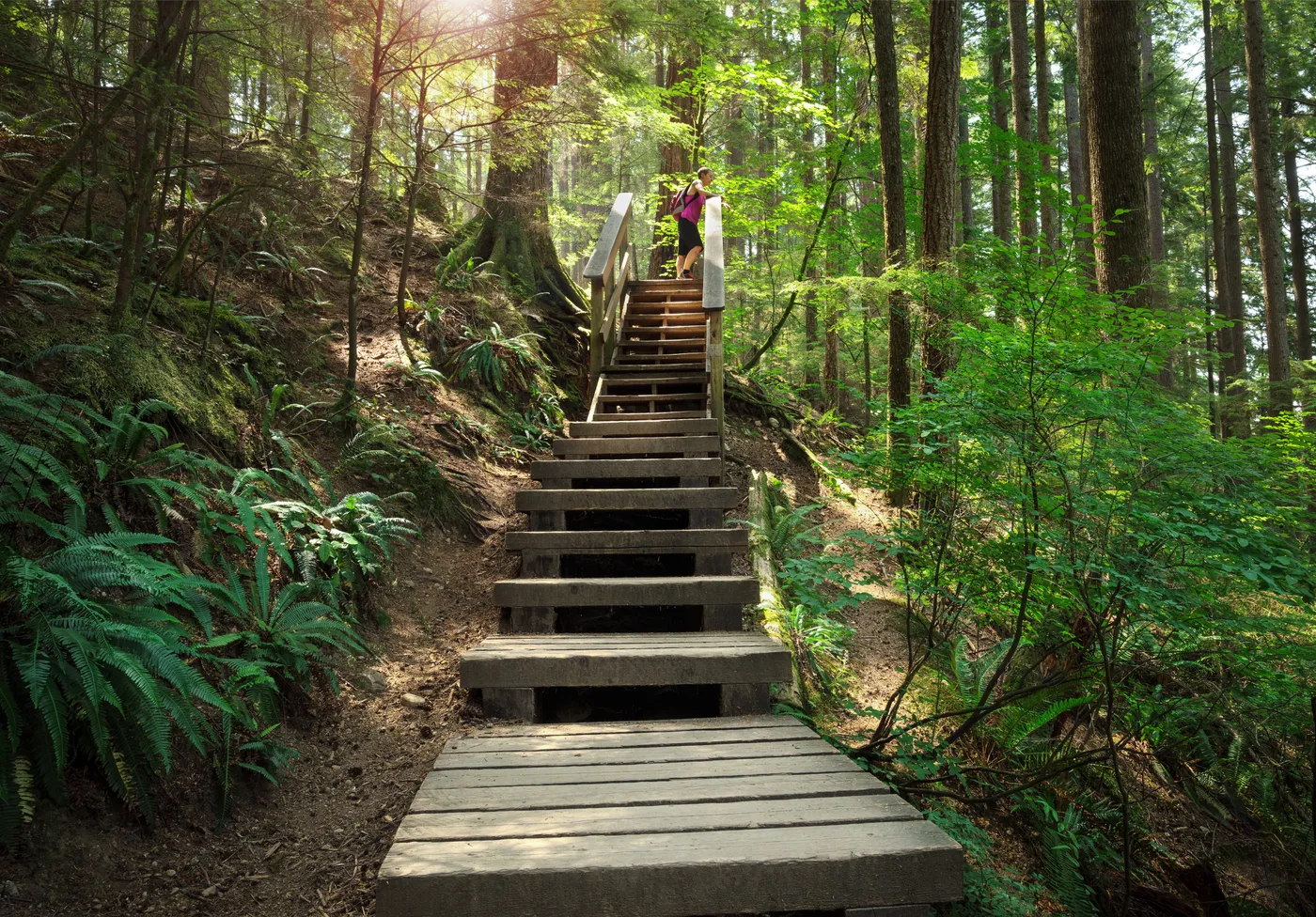
Seek the Peak is sixteen kilometres that behave like two entirely different races. The first part runs from the beach at Ambleside Park in West Vancouver through North Vancouver — flat, fast, deceptively pleasant. Then you reach the base of the Grouse Grind and the day collects roughly 1,400 metres of elevation from you in one go.
Almost everyone who has a bad day at this race has the same bad day: they ran the approach at a pace their legs could hold on the flat and their engine could not hold on the mountain. The plan below is built around not doing that.
What the course actually asks for
Three separate capacities, and training only two of them is the usual reason for a rough finish.
- Sustained running economy on the flat — enough that the approach costs you very little, because it is not where the race is decided.
- Climbing endurance — the ability to hold a hard, repeatable effort uphill for the better part of an hour once your legs already have kilometres in them.
- Step-up strength endurance — the Grind is stairs and roots, not a runnable gradient. This is a strength quality, not a cardio one, and it is the one most runners neglect.
The relay option changes the maths entirely. As a team of two to four splitting the course into legs, you are training for one hard segment rather than the whole day, and it is an excellent first exposure to the event.
The twelve-week shape
Count backwards from race day, which typically falls in mid-June — confirm the current year's date with the organisers before you build a calendar on it. Twelve weeks out lands in mid-March, which is also roughly when the local trails become reliably usable.
| Weeks | Focus | The week's shape |
|---|---|---|
| 1 to 3 | Base and strength | Three runs, mostly easy · two strength sessions · one hilly walk or hike |
| 4 to 6 | Introduce vertical | Three runs including one hill session · two strength sessions · one long climb |
| 7 to 9 | Specificity | Two runs · one Grind or long stair session · two strength · one long trail day |
| 10 to 11 | Peak | The hardest climbing of the block, plus one full dress rehearsal |
| 12 | Taper | Volume drops by roughly half, intensity stays, legs come back |
That is a template, not a prescription. The non-negotiables inside it are: something vertical every week from week four, strength maintained the whole way through, and a genuine taper.
The dress rehearsal
Somewhere in weeks ten or eleven, run the actual thing at reduced scale: an easy 8 to 10 km on the flat, then straight into a Grind at your intended race effort, with no meaningful break between them.
This session is the most valuable one in the block, and it is not primarily physical. It teaches you what your intended flat pace actually costs you when you reach the base of the trail, which is information no amount of separate training provides. Most people discover their planned pace was optimistic by about thirty seconds a kilometre.
Do it once. It is demanding enough that repeating it inside a fortnight eats into the taper.
The strength work that transfers
Two sessions a week, held through the whole block. Do not drop them in the peak weeks — that is exactly when tissue is under most load and most needs support.
- Step-ups, loaded and high. The most directly transferable exercise for this course, because it is what the Grind is.
- Split squats and lunges. Single-leg strength is what climbing actually uses; two-legged squatting is a poor proxy.
- Calf work, patiently. Both straight-leg and bent-knee. Calves are the tissue most likely to end a climbing block early.
- Hinge patterns. Deadlift variations for the posterior chain that drives you up a steep pitch.
- Carries. Trunk stiffness so your posture holds in the last twenty minutes, which is when it otherwise collapses.
None of this is exotic and all of it is ordinary coached strength work. If you would rather have the loads chosen and progressed for you, that is what small group strength training is. Training for North Shore hikers covers the same qualities from the hiking side.
Pacing: the only tactical decision that matters
Run the approach slower than you want to. That is the entire tactical plan, and it is much harder to execute than it is to write.
A useful rule: on the flat, hold an effort you could sustain comfortably in conversation. If you cannot speak in full sentences before you reach the base of the Grind, you have already spent the mountain.
On the climb, settle immediately into a rhythm you can hold rather than chasing anyone. The Grind rewards steadiness savagely — a consistent effort beats a fast start followed by three stops, and passing people at the bottom is the least meaningful thing that will happen to you all day.
Pick a hand-on-thigh cadence and keep the steps small. Big steps feel powerful and burn out the quads that still have four hundred metres of climbing to do. The Grouse Grind training guide has a fuller pacing framework and trail etiquette.
Race week
- Cut volume roughly in half, keep some intensity. A couple of short, sharp efforts stops your legs feeling flat on the day.
- Do your last hard climb ten or more days out. Anything closer is confidence-seeking, not training.
- Eat normally and slightly more carbohydrate than usual in the last two days. Nothing new, nothing exotic.
- Plan the descent before you start. The Grind is one-way; you come down by gondola. Know how that works on race day.
- Rehearse the morning. Getting from home to Ambleside for an early start is its own logistics problem, and solving it at 6 am on race day is a poor use of adrenaline.
Afterwards, expect the descent-free nature of the course to spare your quads and the sustained climb to have thoroughly emptied your legs. Take the following week genuinely easy — the recovery guide covers what that should look like.
Common questions
How fit do I need to be before starting a twelve-week block?
Comfortably running 8 to 10 km and able to walk up something steep for an hour without it being an event. Below that, give yourself a base-building block first and target the following year.
Can I train for it entirely on a treadmill?
Partly. Incline treadmill work builds the engine and a good deal of the climbing endurance, and it is invaluable through a wet spring. It does not teach you the footing, the step height or the rhythm of the actual trail, so get on the Grind itself once it is open.
How many Grinds a week should I do?
One hard one, at most two ascents including an easy one. It is a demanding session and it accumulates faster than most people expect — three a week is how climbing blocks end early.
Is the relay a good first attempt?
Yes, and a genuinely fun one. You train hard for a single leg rather than the whole course, and you get the finish, the atmosphere and a realistic sense of whether you want the solo version next year.
What if I miss two weeks mid-block?
Do not try to make them up. Rejoin the plan where the calendar is, cut one intensity session in the first week back, and carry on. Compressed catch-up training is the most reliable way to arrive injured.